Flat Roof Leak Detection: A 2026 Guide for Poconos Property Owners
What if the water dripping into your hallway isn’t actually coming from the spot directly above your head? For many Poconos property owners, flat roof leak detection feels like a high-stakes game of hide-and-seek because of lateral water migration. Water often enters through a tiny membrane puncture and travels dozens of feet through insulation before it ever reaches your ceiling. It’s a stressful situation, especially when you’re worried about structural rot during a harsh Pennsylvania winter.
We understand how frustrating it is to feel like you’re losing the battle against a hidden leak. This guide will help you master the science of finding those elusive entry points and protecting your investment. You’ll learn the difference between a simple DIY fix and advanced electronic methods like those found in the ASTM D7877 standards. We’ll also walk through the “25% rule” to help you decide if a targeted repair is enough or if a full replacement is the smarter path for your East Stroudsburg building. By the end of this article, you’ll know exactly how to stop the drip and keep your property dry.
Key Takeaways
- Understand how lateral water migration causes “ghost leaks” that appear far from the actual entry point.
- Learn the proper technique for a visual inspection, starting from the interior drip and working your way upstream.
- Explore how professional flat roof leak detection using infrared imaging and electronic sensors can pinpoint moisture trapped deep within your roof’s layers.
- Use the “25% rule” to help you decide when it’s time to stop patching and consider a more permanent solution for your building.
- Gain the confidence to identify early warning signs of structural rot before the Poconos climate causes more extensive damage.
The Challenge of Flat Roof Leak Detection in the Poconos
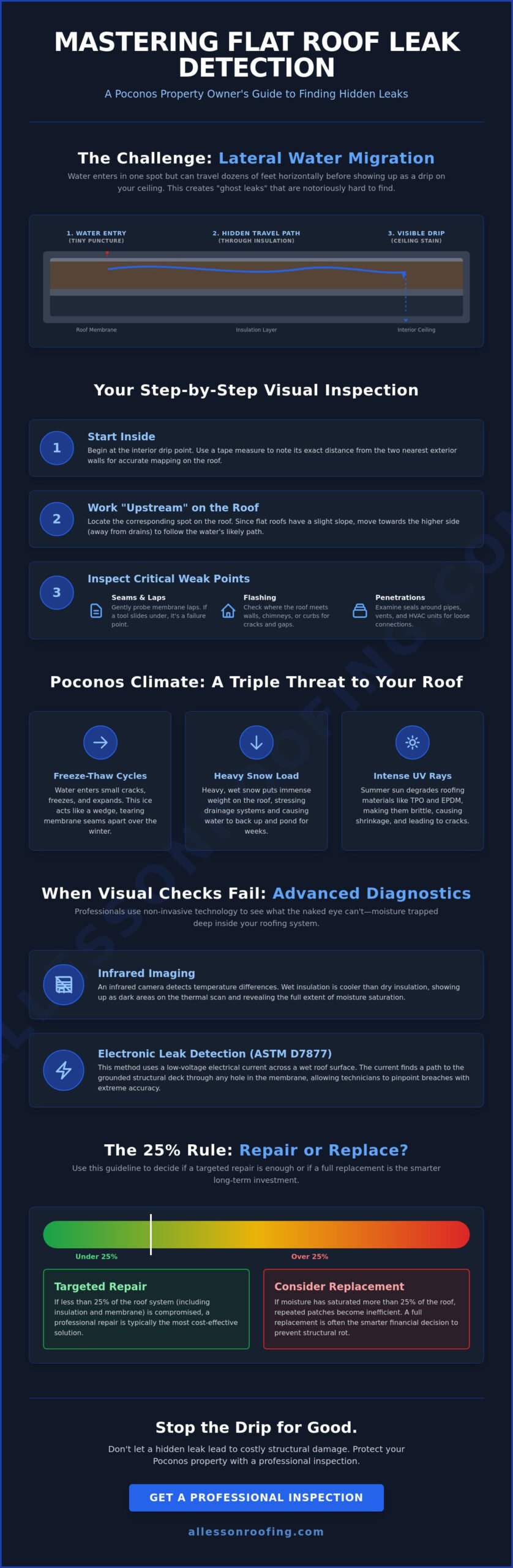
Finding the source of a leak on a flat surface is rarely a straight line from the drip to the hole. This process, known as lateral water migration, is the primary reason why flat roof leak detection can be so frustrating for property owners in our area. Unlike sloped roofs where water runs downward immediately, flat systems allow water to travel horizontally between the roof membrane and the structural deck. It might enter through a small puncture on the north side of your building but only show up as a ceiling stain on the south side.
Because of this horizontal movement, flat roofs are prone to “ghost leaks.” These are leaks that seem to disappear during light rain but return with a vengeance during heavy storms or snow melts. The Challenge of Flat Roofs often involves managing ponding water, which adds weight and pressure, forcing moisture into even the smallest imperfections. If this moisture stays trapped, it creates a breeding ground for mold and can lead to structural rot in your roof’s wooden or metal decking.
Why Water Doesn’t Always Drip Where it Enters
Even though we call them flat, most roofs have a slight pitch designed to move water toward drains or scuppers. Water is lazy; it follows the path of least resistance. This often means moisture travels along electrical conduits, HVAC curbs, or structural steel beams before it finds a gap in the interior ceiling. Capillary action occurs when moisture is drawn into microscopic cracks in a membrane seam through surface tension, allowing water to penetrate areas that look perfectly sealed to the naked eye. This makes visual inspections difficult because the entry point might be smaller than a pinhead.
Climate Factors in East Stroudsburg and Lehigh Valley
Our local weather plays a major role in how leaks develop. In East Stroudsburg and across the Lehigh Valley, the freeze-thaw cycle is a constant threat. When water gets into a seam and freezes, it expands, physically tearing the membrane apart. Heavy snow loads also stress the drainage systems, causing water to back up and sit on the roof for weeks. During the summer, intense UV rays can cause EPDM or TPO membranes to shrink and become brittle, leading to cracks. If you’re managing a larger property, staying ahead of these issues is vital, and you can learn more in our guide to Commercial Roof Repair in the Poconos.
Step-by-Step: Conducting a Visual Flat Roof Inspection
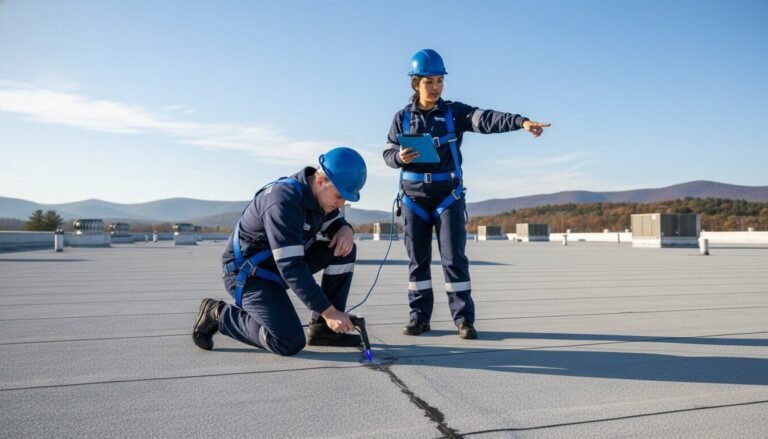
Before you step onto your roof, prioritize your safety. Ensure the surface is dry and wear soft-soled shoes to provide traction without damaging the membrane. Gathering the right tools before you start will make the process much smoother. You’ll need a tape measure, a camera or smartphone, and a blunt tool like a screwdriver to check the integrity of your roof’s components.
The most effective strategy for flat roof leak detection begins inside your building. Start at the interior drip point and measure its distance from the nearest exterior walls. Once you’re on the roof, locate that same spot. From there, work “upstream.” Even roofs that look perfectly level have a slight slope toward drains or scuppers. By moving toward the higher side of the roof, you’re following the likely path the water took before it reached your ceiling. Don’t forget to take clear photos of every suspicious area you find. This documentation is invaluable when you’re ready to share your findings with a contractor.
Inspecting Seams, Flashing, and Penetrations
Most leaks don’t happen in the middle of a clear field of membrane; they happen at the joints. Use a blunt screwdriver or a dedicated seam probe to gently test the membrane laps. If the tool easily slides under a seam, you’ve found a failure point. Pay close attention to the areas where the roof meets a wall or a chimney. These transitions are high-stress zones. If you notice gaps or cracked sealant around your masonry, you might need a Professional Chimney Flashing Repair Service to restore the watertight seal. Also, check the curbs around HVAC units, as vibration can often loosen these connections over time.
Identifying Ponding Water and Membrane Blisters
Look for signs of standing water, often marked by dark rings of dirt or algae. We use the “48-hour rule” as a standard benchmark. If water stays on your roof longer than two days after a rainstorm, your drainage system is failing. This standing water puts immense pressure on your seams. On asphalt-based roofs, look for “alligatoring,” which is a pattern of deep cracks that look like reptile skin. This indicates the material has lost its flexibility. You should also watch for blisters, which are raised bubbles in the membrane. These indicate that air or moisture is trapped underneath, often signaling a leak nearby. If you find multiple blisters or widespread cracking, it’s a good idea to request a professional inspection to determine the depth of the damage.
Advanced Diagnostic Methods: When Visual Checks Fail
Sometimes your eyes simply aren’t enough. If you’ve walked the seams and checked the flashing as described in the previous section but the drip persists, it’s time for high-tech flat roof leak detection. Professional diagnostics remove the guesswork by seeing through the membrane to the layers below. These methods are particularly effective for identifying those “ghost leaks” that travel far from their entry point.
Electronic Leak Detection (ELD) and Thermal Imaging
Thermal imaging is one of the most reliable ways to find trapped moisture without cutting into your roof. We use infrared cameras after sunset once the roof begins to cool. During the day, the Poconos sun heats the entire surface. At night, dry sections of the roof lose heat quickly, but wet insulation underneath the membrane holds onto that warmth. This creates a clear “thermal signature” that shows us exactly where water is hiding.
Electronic Leak Detection (ELD) takes a different approach by using electricity to find breaches. Since materials like EPDM and TPO are non-conductive, they act as insulators. We can use low-voltage or high-voltage methods, often following ASTM D7877 standards, to pass a current across the surface. If there’s a hole, the water creates a path for the electricity to reach the grounded structural deck. These methods are incredibly precise and are often the preferred choice for large commercial buildings in Stroudsburg where manual inspections would take days.
The Risks and Rewards of Flood Testing
Flood testing is a traditional method that involves plugging the drains and filling a specific section of the roof with water. While it’s a definitive way to confirm if a repair worked, it carries significant risks that property owners shouldn’t ignore. Before you consider this method, keep these points in mind:
- Structural Weight: You must verify your building’s structural load capacity. Just one inch of water adds about five pounds of weight per square foot.
- Isolation: Use temporary dams or sandbags to test one small area at a time.
- Monitoring: Someone must be stationed inside the building to watch for immediate leaks.
If you’re managing a business property, you can see how these tests fit into a larger maintenance strategy by reviewing our Commercial Roofing Inspection Checklist. Because of the risk of structural collapse or catastrophic interior damage, we recommend leaving flood testing to the pros. If your visual check left you with more questions than answers, reach out to us for a professional diagnostic session to pinpoint the exact source of your leak.
Finally, if the insulation is already saturated, we may use moisture probes or electrical impedance scanners. These tools help us determine if the roof substrate is still salvageable or if moisture has already begun to rot the decking. Knowing the condition of the substrate is the only way to decide if a patch will hold or if a larger intervention is required.
From Detection to Repair: Next Steps for Your Property
Finding the source of the water is a major win, but the work doesn’t stop there. Once flat roof leak detection is complete, the focus shifts to assessing the collateral damage. Is the insulation underneath still dry, or has it become a saturated sponge? If moisture remains trapped in the roof assembly, a simple surface patch won’t prevent mold growth or structural decay. You must determine if the leak was an isolated incident or a symptom of a failing system.
Professional roofers often use the “25% Rule” as a financial benchmark. If more than 25% of your roof surface is damaged or the underlying insulation is widespread with moisture, a full replacement is usually more cost-effective than a series of expensive, localized repairs. Patching a roof that has reached the end of its lifespan only delays the inevitable and often leads to higher emergency costs down the road.
Repairing vs. Replacing Your Flat Roof
The right choice depends heavily on your roof’s material. For EPDM or TPO membranes, small punctures are often easily fixed with specialized adhesive patches. However, if you have an older Modified Bitumen roof that is “alligatoring” or losing its granules, the material may be too brittle to accept a new seal. We always weigh the cost of repeated service calls against the long-term value of a new installation. To help you weigh these options, check out our detailed guide on Flat Roof Repair vs Replacement.
Why Local Expertise Matters in the Poconos
Hiring a contractor who understands the specific demands of the Poconos climate is vital. As of January 1, 2026, Pennsylvania adopted updated building codes based on the 2021 International Code Council series. These standards include stricter requirements for ice barriers and ventilation that are essential for our region’s heavy snow loads and freeze-thaw cycles. A local expert ensures your repairs meet these legal requirements while standing up to East Stroudsburg winters.
At Allesson Roofing, we take pride in being a dependable partner for our neighbors. We don’t just look for the leak; we look for the cause. Whether you’re managing a commercial warehouse or a residential flat roof, we provide transparent diagnostics and straightforward solutions. Regular maintenance is the best way to avoid the stress of flat roof leak detection in the middle of a storm. If you suspect your roof is holding onto moisture or you’ve spotted a new ceiling stain, don’t wait for the damage to spread. Contact Allesson Roofing for a Professional Inspection and let us help you protect your property with confidence.
Secure Your Property Against Hidden Water Damage
Don’t let a small ceiling stain turn into a structural disaster. You’ve learned how lateral water migration can hide the true source of a leak and how advanced tools like infrared cameras pinpoint moisture before it causes rot. Whether you’re performing a visual check on your seams or evaluating your roof using the 25% rule, staying proactive is the best way to protect your investment in the Poconos.
Effective flat roof leak detection requires a combination of local knowledge and specialized equipment. As specialists in EPDM and TPO systems, we understand the unique stresses our climate puts on your property. From routine maintenance to emergency storm damage response, we are here to provide the steady, professional guidance you need to keep your building safe and dry.
If you’re tired of chasing ghost leaks or want to ensure your building meets the latest 2026 PA building codes, we’re ready to help. Schedule a Professional Flat Roof Inspection with Allesson Roofing today. Our East Stroudsburg team is committed to keeping your property in peak condition. You don’t have to face the next storm alone; we’re just a call away.
Frequently Asked Questions
How much does professional flat roof leak detection cost in PA?
The cost for professional diagnostics depends on the size of your roof and the specific technology required, such as infrared thermal imaging or electronic sensors. While a standard visual assessment is a common starting point, more advanced methods involve specialized equipment that provides a definitive map of trapped moisture. Investing in professional flat roof leak detection early is almost always more affordable than waiting for a leak to cause structural rot or mold growth.
Can I use a garden hose to find a roof leak myself?
You can use a garden hose to perform a “hose test,” but you must be extremely careful not to add too much weight to your roof. Start at the lowest point of the roof and slowly work your way toward the higher side while a helper stays inside to watch for drips. If you introduce too much water too quickly, you risk exceeding the structural load capacity of your building, especially if your drainage system is already struggling with debris or ice damage.
What are the most common causes of flat roof leaks in East Stroudsburg?
Most flat roof failures in East Stroudsburg are caused by the Poconos’ intense freeze-thaw cycles and heavy snow loads. When water gets into a small seam and freezes, it expands and tears the membrane, creating a wider entry point for the next storm. Other common issues include UV degradation that makes EPDM or TPO membranes brittle and ponding water that sits on the surface for longer than 48 hours, eventually forcing its way through the flashing.
Does insurance cover flat roof leak detection and repair?
Property insurance typically covers roof leak repairs if the damage was caused by a sudden, accidental event like a severe windstorm or a fallen tree. However, most policies do not cover leaks resulting from age, general wear and tear, or a lack of routine maintenance. It’s a good idea to speak with your insurance agent to confirm if your policy includes coverage for professional diagnostic services and the resulting interior repairs.
How long does a flat roof usually last in the Poconos climate?
A well-maintained flat roof in the Poconos generally lasts between 15 and 25 years depending on the material used. While EPDM and TPO are highly durable, the constant stress of Pennsylvania winters can shorten their lifespan if they aren’t inspected regularly. If your roof is approaching the 20-year mark or if you find that repairs are needed on more than 25% of the surface, it’s often more practical to plan for a replacement rather than continuing to patch old material.
What is the best time of year to perform a flat roof inspection in Pennsylvania?
We recommend scheduling a professional inspection twice a year, specifically in the late spring and the early fall. A spring inspection allows you to identify and fix any damage caused by winter ice dams and heavy snow accumulation. An autumn check ensures your drainage systems are clear and your seams are watertight before the next cycle of freezing temperatures begins. Staying ahead of these changes helps you avoid the high cost of emergency winter repairs.