Why a New Roof Costs More Than the Shingles Do
You priced a bundle of architectural shingles at the home improvement store, did the math on your roof, and the number came out to a fraction of the quote sitting on your kitchen table. So why is a new roof so expensive when the shingles themselves look cheap?
Because the shingles are one line on a quote that has a dozen lines. Everything underneath them — the tear-off, the dumpster, the decking, the underlayment, the ice barrier, the metal at the edges — plus the crew hours to put it all on, is the rest of the job. That’s what you’re buying.
Here’s where the money actually goes, and what the shelf price on a bundle leaves out.
The short answer: you’re buying a roof system, not a pile of shingles
A roof replacement quote covers a full system, not just shingles. It pays for tearing off and hauling away the old roof, replacing rotted decking, new underlayment, an ice barrier at the eaves, flashing and drip edge, ventilation, fasteners, the permit, cleanup, and the crew hours to install all of it correctly.
The shingles are the only part you can see from the driveway, so they’re the only part most homeowners price. Here’s the whole list:
| Line on the quote | What it is | Included in the shelf price of a bundle? |
|---|---|---|
| Tear-off | Stripping the old roof down to the wood | No |
| Disposal | Dump trailer or container, plus landfill fees by weight | No |
| Decking repair | Replacing plywood or board sheathing that’s rotted or delaminated | No |
| Underlayment | The synthetic layer that goes over the whole deck | No |
| Ice barrier | Self-adhering membrane at eaves and valleys | No |
| Drip edge and flashing | Metal at the edges, walls, chimney and pipes | No |
| Starter strip and ridge cap | The first course and the capped ridge — different products from field shingles | No |
| Ventilation | Ridge vent and intake, so the attic can breathe | No |
| Fasteners | Roofing nails, in the length the deck requires | No |
| Shingles | The part you priced | Yes |
| Labor | The crew, the setup, the safety gear, the cleanup | No |
| Permit | Pulled with the township | No |
One line out of twelve. That’s the whole answer to why a new roof is so expensive, and everything below is the detail.
Where the rest of the money goes
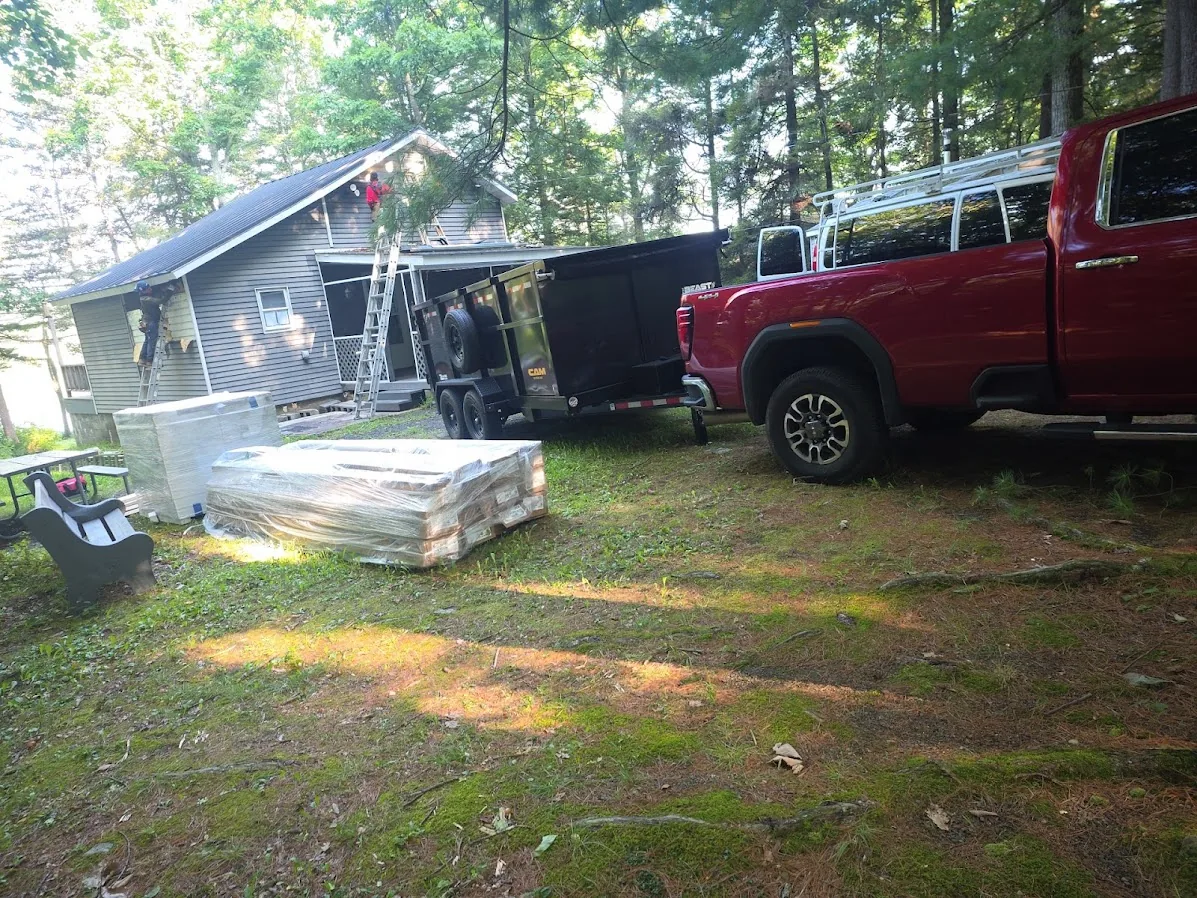
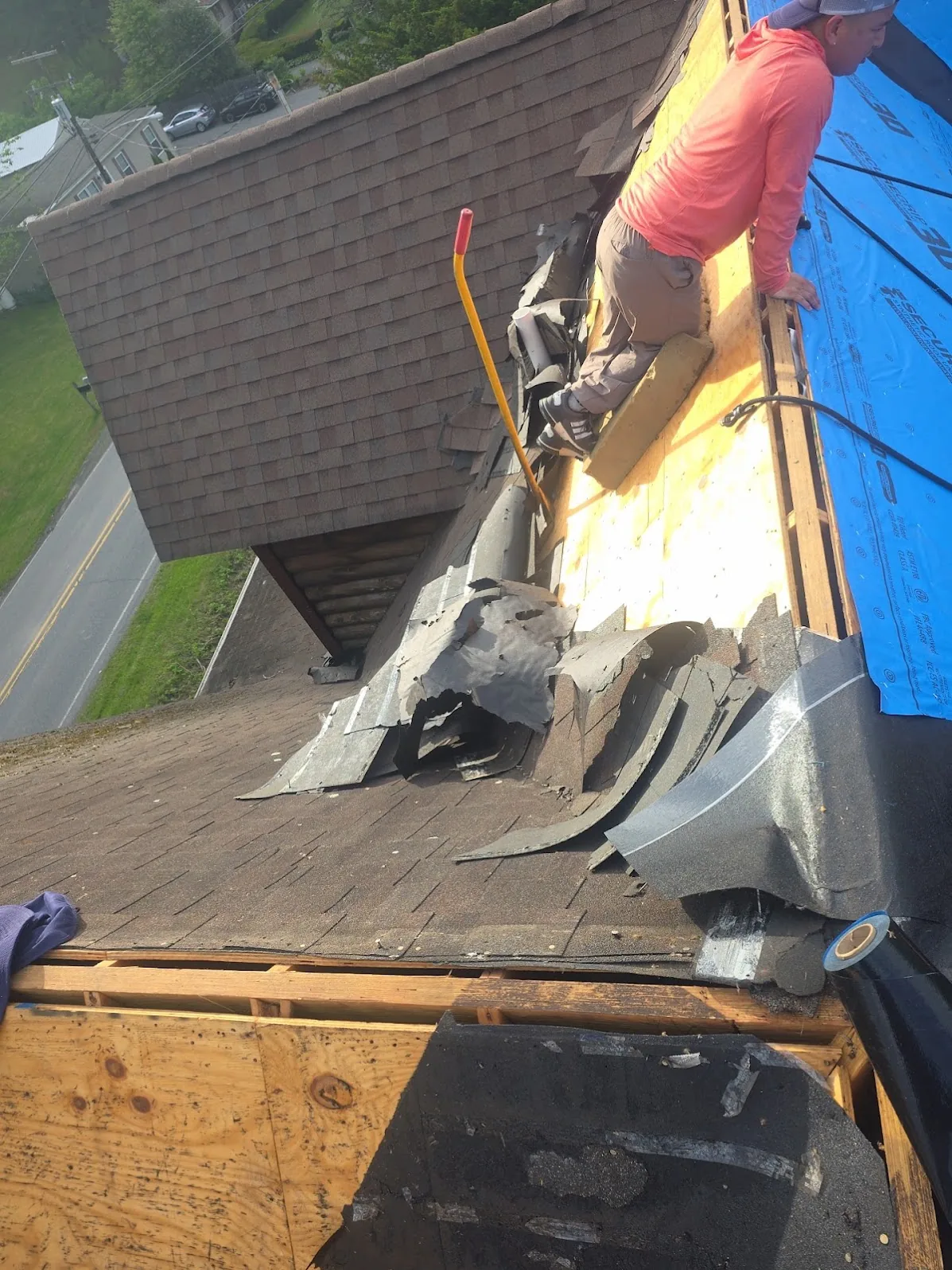
The old roof has to leave. Before a single new shingle goes on, the old one comes off and has to go somewhere. That means a dump trailer or container parked in your driveway, the labor to fill it, and a landfill that charges by the ton. An old roof is heavier than people expect — it’s asphalt and mineral granules, and it soaked up water for twenty years.
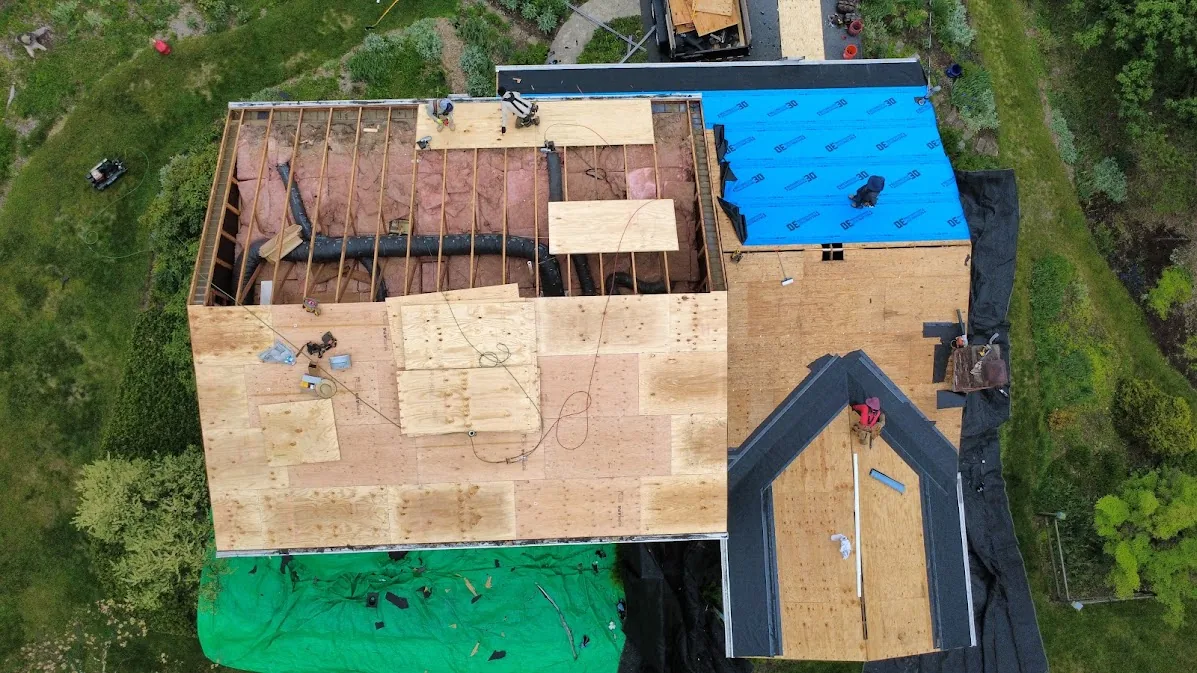
The wood underneath is a coin flip. Nobody, including us, can tell you the condition of your decking until the old roof is off. We’ve stripped roofs in East Stroudsburg that were perfect underneath and roofs where three sheets of plywood came out with the shovel. A good quote handles this honestly: it names a per-sheet price for replacement decking so you know the number before it happens, instead of hiding it and “discovering” it on day two.
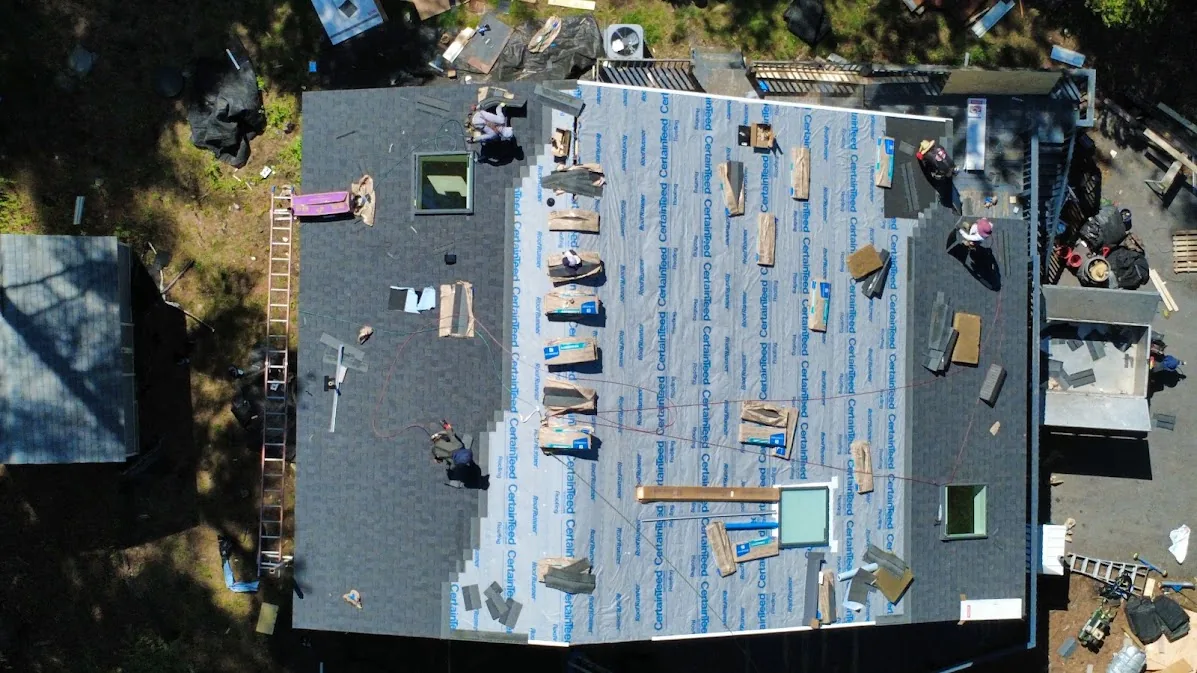
Then come the layers you’ll never see again. Synthetic underlayment over the entire deck. Ice-and-water membrane at the eaves and in the valleys. Drip edge along the rakes and eaves. Step flashing where the roof meets a wall. New boots at every pipe. Ridge vent along the peak. Each of those is a separate material with a separate cost, and each is the reason a roof lasts or leaks. Skip the flashing and you’re calling somebody for asphalt shingle repair in three winters.
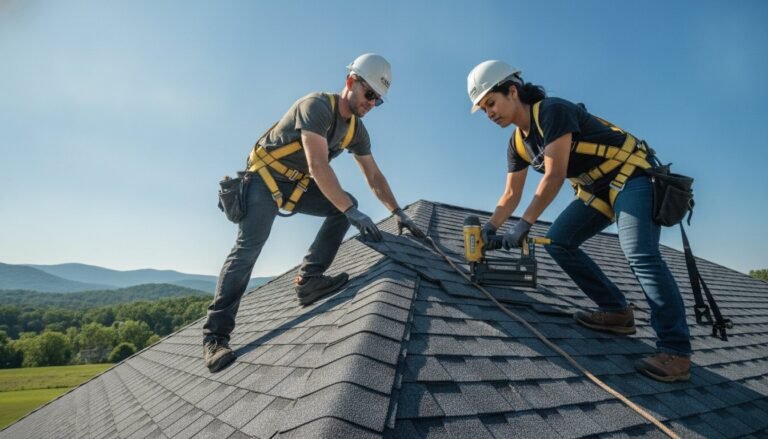
And most of the invoice is people. A crew doesn’t just nail shingles. They set up ladders and harnesses, tarp your landscaping, strip the roof, sweep the yard with a magnet for nails, and haul everything away — usually inside two or three days, on a surface that’s steep and forty feet up.
What the store price on a bundle doesn’t include
The shelf price is real. It’s just not the price of a roof.
Shingles are sold by the square, not by the roof. A square is 100 square feet of roof surface, and most architectural shingles run three bundles to a square. A 1,800-square-foot house doesn’t have 18 squares of roof, either — pitch and overhangs make the roof surface bigger than the floor plan, sometimes by a third or more.
Waste is not optional. Every valley, hip and rake gets cut, and the offcuts go in the trailer. Nobody orders exactly the square footage of the roof, because you’d run out on the last day and have to match a new lot.
Speaking of lots: shingles are manufactured in batches, and bundles carry a lot number. Mix bundles from different production runs across one roof slope and you can get visible color banding in direct sun. Buying odds and ends off a shelf over three weekends is exactly how that happens.
The accessories are separate products. Starter strip, hip and ridge cap, underlayment, ice barrier, drip edge, nails and pipe boots are each priced on their own — and bought one at a time at retail, they add up faster than the field shingles do.
And then it has to get up there. Suppliers deliver roofing material and, on most jobs, load it onto the roof. That’s a service, and it’s in the price a contractor pays. Your pickup truck is not that service.
Why the materials themselves are more expensive in 2026
This part isn’t a sales line — it’s published data, and almost no roofing blog cites it.
The Bureau of Labor Statistics tracks a producer price index for asphalt shingle and roofing material manufacturing. In July 2026 it hit 380.3 — the highest reading in the entire series, which goes back to June 1984. That’s up 3.6% from July 2025, and up 7.5% since March of this year. Most of that jump happened in June and July.
Two honest caveats. First, that index measures what manufacturers charge, not the sticker at your local supply house — but it’s the wind direction, and shelf prices follow it. Second, the metal parts of your roof (drip edge, flashing, gutters) have been sitting under tariffs that have changed rates three times in the last fourteen months, so anyone who quotes you a firm percentage for that is guessing.
What it means for you is simple: a quote from 2024 is not a useful benchmark for a quote today, and quotes have shorter shelf lives than they used to. If you want actual numbers rather than direction, we keep them in a separate guide on what asphalt shingle installation actually runs in Pennsylvania and in our breakdown of current price ranges for the Poconos.
What a Poconos roof needs that a generic quote skips
National price calculators are built for national averages. We’re at 1,800 feet with 50 to 100 inches of snow a year and a freeze-thaw cycle that runs from November through March. Three things follow from that.
The ice barrier isn’t an upgrade here. Where there’s a history of ice forming along the eaves, the residential code Pennsylvania’s Uniform Construction Code is built on — IRC R905.1.2 — requires a self-adhering membrane from the roof edge to at least 24 inches inside the exterior wall line. On roofs steeper than 8-in-12, it goes 36 inches up the slope. Monroe County qualifies. If a quote doesn’t mention the ice barrier at all, that’s the first question to ask.
Ventilation is what stops the ice dam. Ice dams don’t start with the shingles, they start with warm air leaking into a cold attic, melting snow that refreezes at the eave. Ridge vent without matching intake at the soffit does almost nothing, and it’s one of the most common things we find on roofs that are otherwise fine.
And the same roof costs more up here than it does in the valley. Steeper pitches, tree cover, longer drives for delivery, and a shorter working season all show up in the labor line on a roof replacement in the Poconos.
How to read two quotes side by side
If two numbers are thousands apart, they’re usually not pricing the same job. Ask both contractors these, in writing:
- Is tear-off included, or is this a layover? A second layer over the old roof is a different job at a different price.
- How many layers are coming off? Two layers is roughly twice the tear-off labor and twice the disposal.
- Is disposal in the number, or billed separately?
- What’s the rate for replacement decking, per sheet? If it isn’t in the quote, it’s a blank check.
- What underlayment, by name? “Synthetic underlayment” is a category. Ask for the product.
- Where does the ice barrier go? Eaves only, or eaves and valleys?
- Is new drip edge and step flashing included, or are they reusing the old metal? Reusing old flashing is the single most common corner cut we find.
- Who pulls the permit, and is it in the price?
Run that list and the cheap quote either explains itself or falls apart. Both outcomes are useful.
When buying your own materials actually makes sense
Here’s the part that doesn’t help us.
Sometimes it does make sense. If you’re patching a small section and you have leftover bundles from the original install in your garage, use them — the color will match better than anything you can buy today. Same for a shed, a detached garage, or a porch roof you’re doing yourself with a weekend and a helper.
On a full replacement, it almost never pencils out. You’d pay retail on twelve product categories a contractor buys at supply-house pricing, you’d own every ordering mistake, you couldn’t return opened bundles, and most manufacturer system warranties only apply when their full system of components goes on together and to spec. A pile of mixed-brand accessories can cost you coverage you didn’t know you had.
And one more honest thing: a cheaper quote isn’t automatically a bad quote. Sometimes it’s an honest crew with lower overhead who scoped the job differently. The eight questions above tell you which one you’re looking at — the price tag by itself never does.
Frequently asked questions
Can I buy my own shingles and just pay a contractor for labor?
Some contractors will do it; many won’t. The ones who do usually won’t warranty materials they didn’t buy, and any shortage or ordering mistake becomes your problem mid-job. On a full replacement, the savings are usually smaller than homeowners expect.
Why do roofing quotes for the same house vary so much?
Almost always because they’re not the same job. Tear-off versus layover, the underlayment and flashing spec, whether disposal and permit are included, and whether decking replacement is priced up front. Match the scope first, then compare the numbers.
What is a roofing square?
A square is 100 square feet of roof surface — the unit roofers use to price and order. Most architectural shingles come three bundles to the square. Your roof has more square footage than your floor plan because of pitch and overhangs.
Does the quote usually include removing the old roof?
It should, but read it. Tear-off and disposal are two of the biggest non-shingle costs on the invoice, and a quote that leaves either one out will look cheaper than one that includes both.
Will roofing materials get cheaper later this year?
Nobody knows, and anyone who tells you otherwise is selling. What we can say is that the producer price index for shingle materials hit its all-time high in July 2026, so waiting is not currently a discount strategy.
Get a quote you can actually read
We’ve been putting roofs on Poconos homes for more than a decade, we’re insured, and we’ll put the certificates in your hands before you sign anything. Our estimates spell out tear-off, disposal, decking rate, underlayment by name, ice barrier coverage and flashing — so you can hold them next to anyone else’s and see exactly what’s different.
Inspections are free, whether you need a full new roof installation in Stroudsburg or just a straight answer about how many winters your current roof has left. Call (570) 426-3505 and we’ll come look at it.
— Manuel Lema, Allesson Roofing