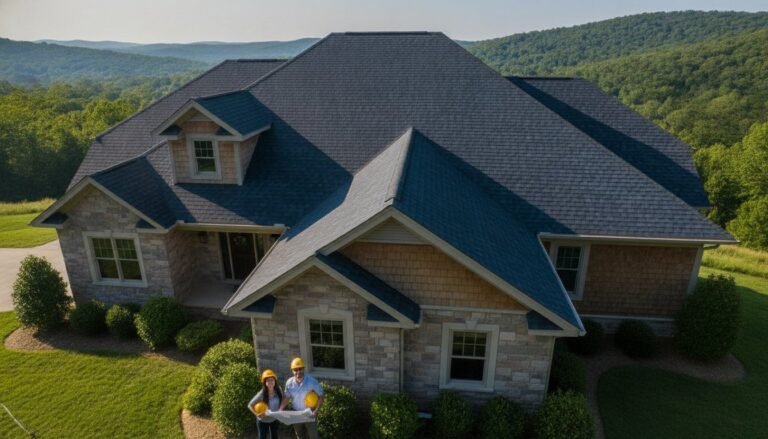
Can You Put a New Roof Over an Old One in Pennsylvania?
Short answer: usually yes. In Pennsylvania you can generally install one new layer of asphalt shingles over one existing layer — never over two — and the code blocks a roof-over entirely in three specific situations. An overlay saves you the cost of the tear-off, which on most homes is 10–20% of the job — not half.
The longer answer is the one that matters, because “allowed” and “a good idea” are different questions. On a Poconos roof there’s one consequence in particular that almost nobody explains before the contract gets signed, and it has to do with ice.
What Pennsylvania code says about a second layer of shingles
Pennsylvania builds under the Uniform Construction Code, which adopts the International Residential Code. As of permits applied for after January 1, 2026, the state moved to the 2021 edition of those codes, so that’s the version your township inspector is working from this year.
Under that code, a roof recover is not permitted when any of these are true:
- The existing roof is water-soaked or deteriorated to the point that it’s no longer an adequate base for new roofing.
- The existing covering is slate, clay, cement or asbestos-cement tile.
- The roof already has two or more applications of any type of roof covering.
That second item matters more here than in most of the state. Around Bangor and the rest of the Slate Belt, plenty of homes still wear their original slate. You cannot shingle over it — not as a shortcut, not with the owner’s blessing. It comes off first.
Item three is the hard ceiling: a third layer is never legal, anywhere in Pennsylvania. If your house already has two, the only path forward is a tear-off. Individual municipalities can also be stricter than the state minimum, and some require a tear-off regardless, so the permit conversation happens before the material order, not after.
What a roof-over actually saves you
Tear-off is labor, a dumpster, and dump fees. National cost data puts removal and disposal at roughly $1 to $3 per square foot, or about $1,500 to $3,000 on a typical 2,000-square-foot roof. A single 25-square tear-off generates three to five tons of debris, which is why the dumpster and the transfer station fees are a real line item and not padding.
What skipping it doesn’t do is cut the price in half. The shingles, underlayment, drip edge, ridge vent, flashing and labor to install the new roof are all unchanged. Homeowners hear “no tear-off” and expect a 40% discount; the real number is closer to a tenth or a fifth of the job, and it arrives with trade-offs a tear-off doesn’t have.
That gap gets narrower every year, too. Shingle manufacturers pushed through price increases in early 2026, so the material side of the quote — the part an overlay doesn’t help with — is a bigger share of the total than it was two years ago.
The five things an overlay hides
The deck. Once the old shingles are off, we can see and walk every square foot of sheathing. Soft spots, delaminated OSB, and the wet patch under a chimney get found and replaced. On a recover, that plywood stays buried and keeps rotting under two layers of shingles.
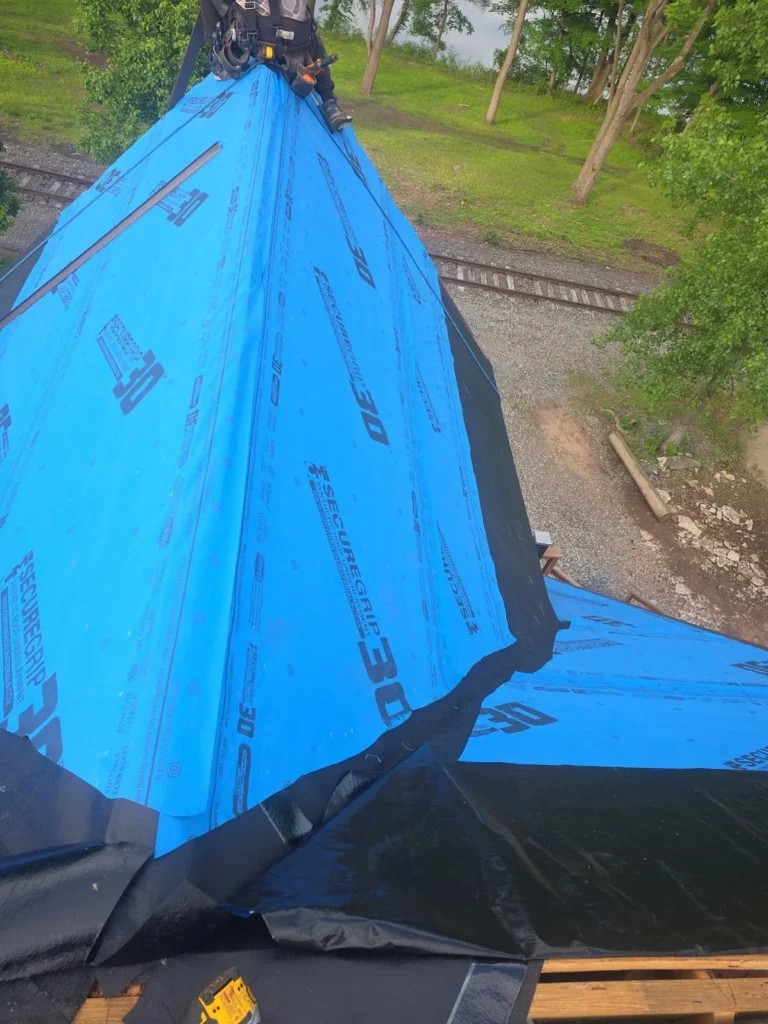
The ice barrier — and this is the big one up here. The code requires an ice barrier in areas with a history of ice forming along the eaves: a self-adhering membrane (or two cemented layers of underlayment) running from the lowest edge of the roof to a point at least 24 inches inside the exterior wall line. That’s the Poconos in one sentence. The membrane only works when it’s stuck to a clean deck — which means a roof-over cannot give you one. If your home is at elevation in Mount Pocono, Bushkill or anywhere else that gets ice dams along the eaves, an overlay leaves the most vulnerable part of your roof protected by whatever was under the old shingles in the first place. Often that’s felt paper from the Clinton administration.
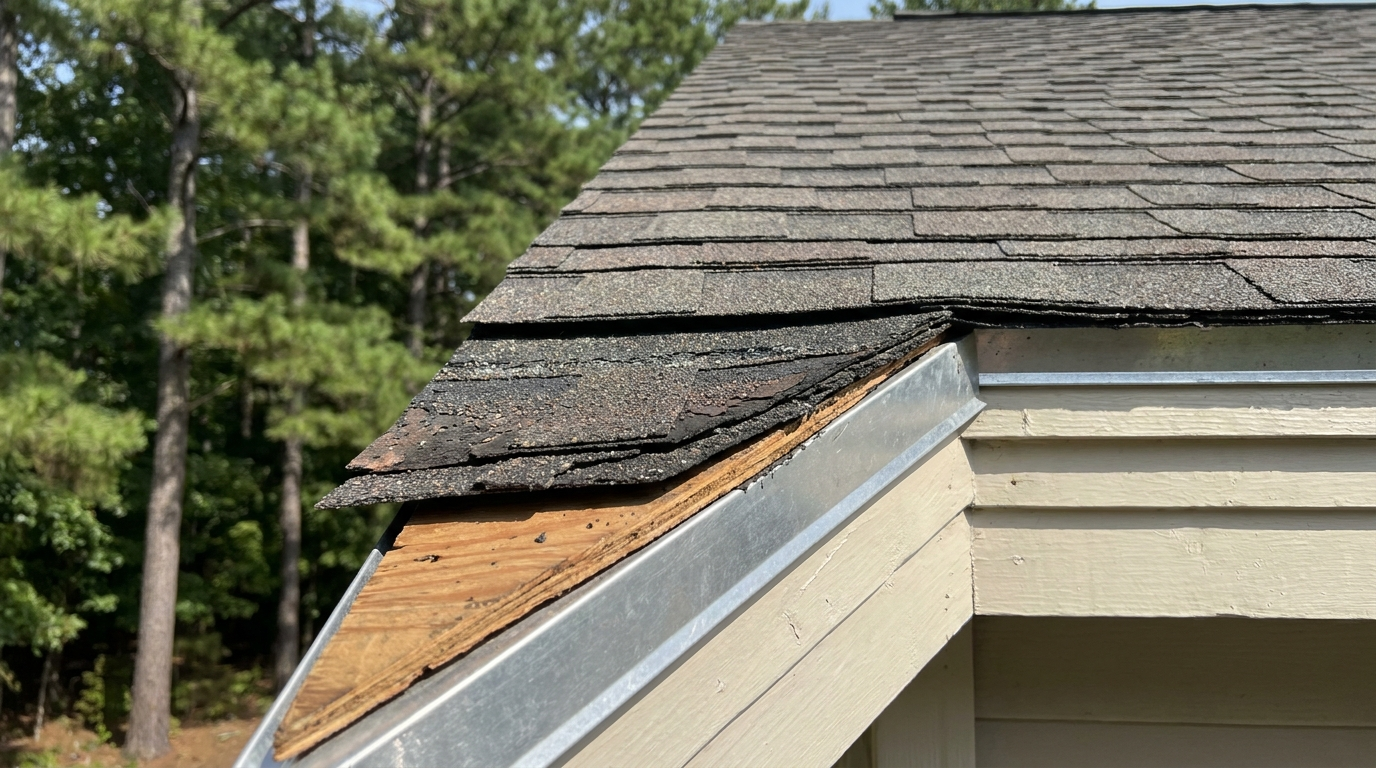
Fastener depth. Nails have to penetrate the roofing materials and go at least ¾ inch into the sheathing. Through two layers of shingles, that requires longer nails — and short nails are the single most common defect we find on failed overlays. They hold in September and let go in the first February wind event.
The flashings. A proper replacement means new step flashing, new valley metal, new pipe boots. On a recover it’s tempting to shingle up to the old flashing and caulk the difference, and chimney flashing is already the leak we’re called out for most often around East Stroudsburg.
Weight. A second layer of architectural shingles adds roughly 2 to 2.5 pounds per square foot — about two tons on a 2,000-square-foot roof — and that load sits there year-round, before the snow arrives. On most framing that’s within tolerance. On an older cabin with 2×6 rafters at 24 inches, it deserves a look before anyone orders material.
Will a second layer shorten the life of my new roof?
Yes, though the honest answer is “somewhat, and it depends.” Shingles laid over shingles don’t lie perfectly flat, so they telegraph every ridge and cupped tab underneath, and the high spots wear their granules off first. The assembly also holds more heat, and heat is what drives asphalt shingles to dry out and lose flexibility.
Expect an overlay to give up a few years against a properly installed tear-off on the same house. If you want the full picture on service life in this climate, we’ve written about how long asphalt shingles last in Pennsylvania and what shortens them here specifically.
The warranty is worth checking before you decide. An overlay usually keeps a basic limited materials warranty, but it typically disqualifies the job from the top-tier manufacturer systems — GAF’s Golden Pledge, Owens Corning’s system coverage and their equivalents all assume installation over a clean deck. Those are the warranties that cover labor and tear-off later; the basic one covers a defective shingle and nothing else.
Will my insurance company or a future buyer care?
Both, sometimes more than the code does.
Carriers are underwriting roofs aggressively right now, and a two-layer roof reads as higher risk: heavier, harder to inspect, and more expensive to claim because a future replacement includes tearing off both layers. Some carriers ask the question directly on the application.
Buyers find out too. Layer count shows up in the home inspection report — the inspector counts at the rake edge — and it lands in the negotiation as “this roof will need a full tear-off.” A buyer’s agent will ask for more off the price than you saved by skipping the tear-off. If you’re planning to sell within a few years, an overlay is usually a losing trade.
When a roof-over is genuinely the right call
We install them, and we’ll recommend one when it fits. The conditions worth having:
- One existing layer only, lying flat, well adhered, with no cupping or curling.
- A dry, solid deck — verified from inside the attic, not assumed from the driveway.
- Adequate ventilation already in place.
- A low-risk roof section: a detached garage, an addition, a shallow-pitch porch away from the ice-prone eaves.
- A budget that genuinely can’t reach a tear-off this season, where the choice is an overlay now or a failing roof through another Poconos winter.
That last one is real, and we’d rather say it out loud than pretend everyone can write a check for the better option. A sound overlay beats a leaking roof by a wide margin.
How do I tell how many layers my roof already has?
Look at the rake edge or the eave from a ladder — at the drip edge you can see the stacked courses in cross-section and count them. A vent stack or the edge of a valley gives you the same view. If you have your last home inspection report, layer count is almost always noted in the roof section.
Don’t guess from the attic; you’re looking at the deck from below and can’t see what’s stacked on top. And if you’re not comfortable on a ladder, this is a five-minute answer for any roofer who’s already coming out to look.
Do I need a permit to re-roof in Monroe County?
Usually, yes — most municipalities here require a permit for a full re-roof or recover, while small like-for-like repairs are often exempt. Requirements vary by township and borough, so the answer for Stroud Township isn’t automatically the answer for Coolbaugh. Confirm with your municipal code office, or let your contractor pull it; a permitted job also means an inspector verifies the layer count, which is protection you’re already paying for.
The decision in three lines
If your roof has two layers, is slate, or the deck is soft, the choice is already made — it’s a tear-off. If it has one flat, sound layer and your budget is tight this season, an overlay is a legitimate option worth pricing. And if your eaves ice up every winter, the missing ice barrier alone is usually enough reason to tear off, because the leak that shows up in your ceiling in February won’t care what you saved in September.
We quote both ways on the same visit, so you can see the actual spread on your roof instead of a rule of thumb: full tear-off and roof replacement in the Poconos beside a recover, with the deck condition and layer count confirmed before either number is written. If what you actually need is a section of shingle repair rather than a whole roof, we’ll tell you that too — it happens more often than you’d think.
Free inspection across Stroudsburg, East Stroudsburg, Mount Pocono and Monroe County. Call (570) 426-3505 and we’ll count the layers, check the deck, and give you both numbers in writing. Planning a full new roof installation in Stroudsburg instead? Same visit, same honest answer.