

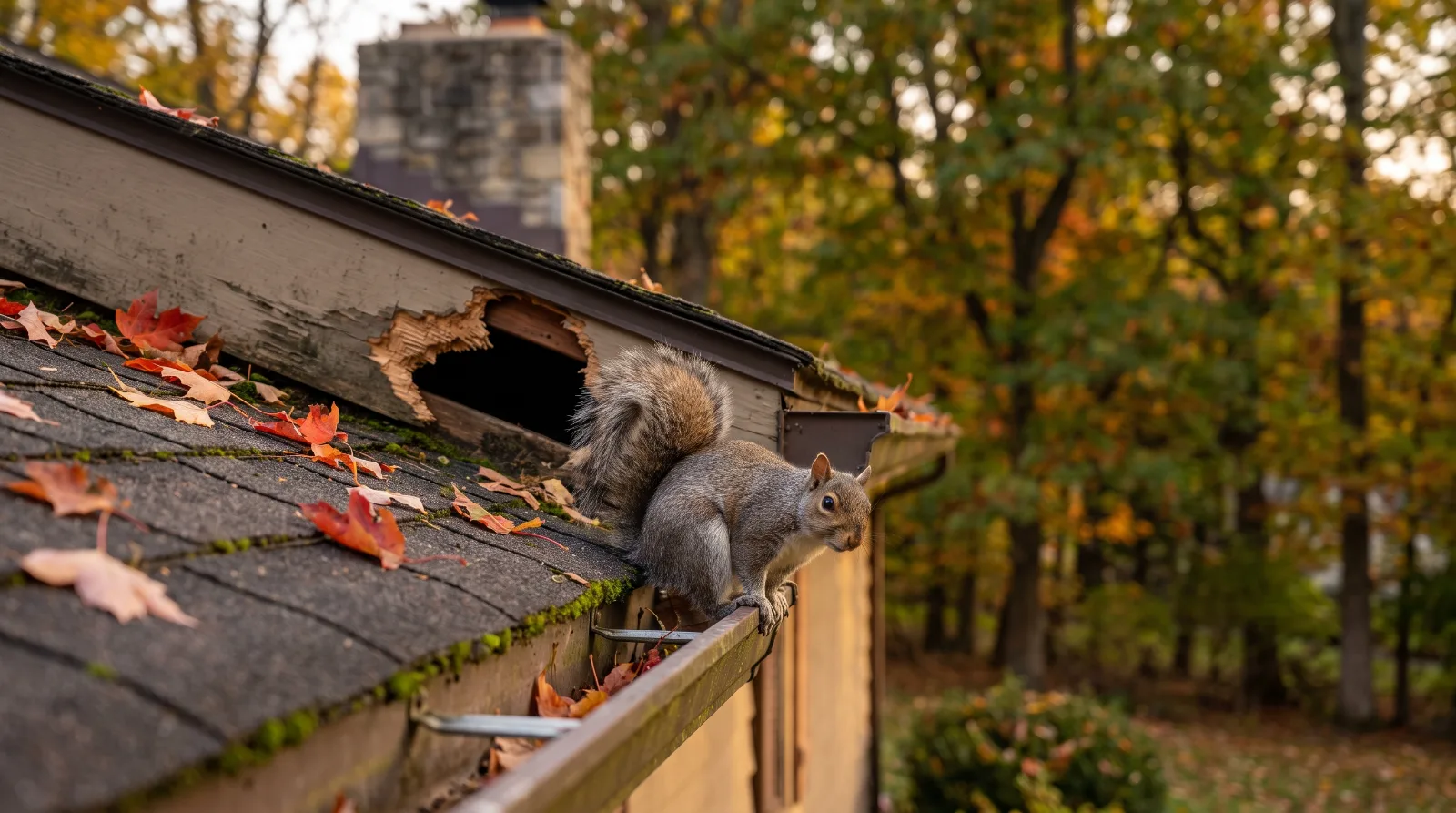
Squirrels in the Attic? The Roof Damage to Check This Fall
If you’re hearing scratching and scurrying overhead at dawn and again late in the afternoon, you almost certainly have squirrels in the attic. Fall is when they move in: gray squirrels are looking for a dry, warm place to ride out the winter, and a gap at the roofline is a lot easier than a hollow tree. Getting them out is a wildlife job. Finding and closing every hole they used, and repairing what they chewed, is a roofing job. Expect $500 to $1,500 for professional removal from an attic, plus repairs that start around $150 for a single small hole.
Why squirrels move into Poconos attics in the fall
According to the Pennsylvania Game Commission, gray squirrels have two litters a year, one in spring and one in late summer. By September those late-summer young are getting independent, the adults are caching acorns, and every squirrel in the neighborhood is shopping for a winter den. A warm attic with loose fiberglass to shred into bedding beats a leaf nest in an oak by a mile.
The houses they pick aren’t random. Homes on wooded lots in Dingmans Ferry, Bushkill and the private communities around Pike County have tree limbs within jumping distance of the roof. Squirrels can clear several feet horizontally, so a branch overhanging the eave is a highway. Second homes are the other favorite. Nobody is there on a Tuesday in October to hear the chewing, so by the time the owners come up for Thanksgiving, the squirrels have been in residence for weeks.
How to tell it’s squirrels and not mice, raccoons or bats
Timing is the giveaway. Match what you hear to the clock:
| What you hear | When | Most likely |
|---|---|---|
| Running, scratching, rolling sounds like acorns | Early morning and late afternoon | Gray squirrels |
| Light scratching, gliding thumps | After dark, all night | Flying squirrels |
| Heavy thumping, walking sounds | Night | Raccoons |
| Faint scratching inside walls | Night | Mice |
| Squeaking and rustling at dusk | Evening, as they leave | Bats |
From outside, look for a chewed, rounded opening about the size of a baseball at the roofline, fresh wood shavings on the shingles or in the gutter, and dark rub marks around the edges of the hole. Inside the attic, you’ll find tunnels through the insulation, leaf-and-fiberglass nests packed against the eaves, and droppings near the entry point.
A note on flying squirrels in the Poconos
Flying squirrels in Pennsylvania attics are almost always the southern species, which is common statewide. But the Poconos are also home to most of the state’s remaining northern flying squirrels, which Pennsylvania lists as endangered and protects under the Game and Wildlife Code. If what you’re hearing is active at night and you live near older spruce or hemlock woods, don’t trap anything yourself. Call the Game Commission first.
Where squirrels get into the roof: the six spots we check first
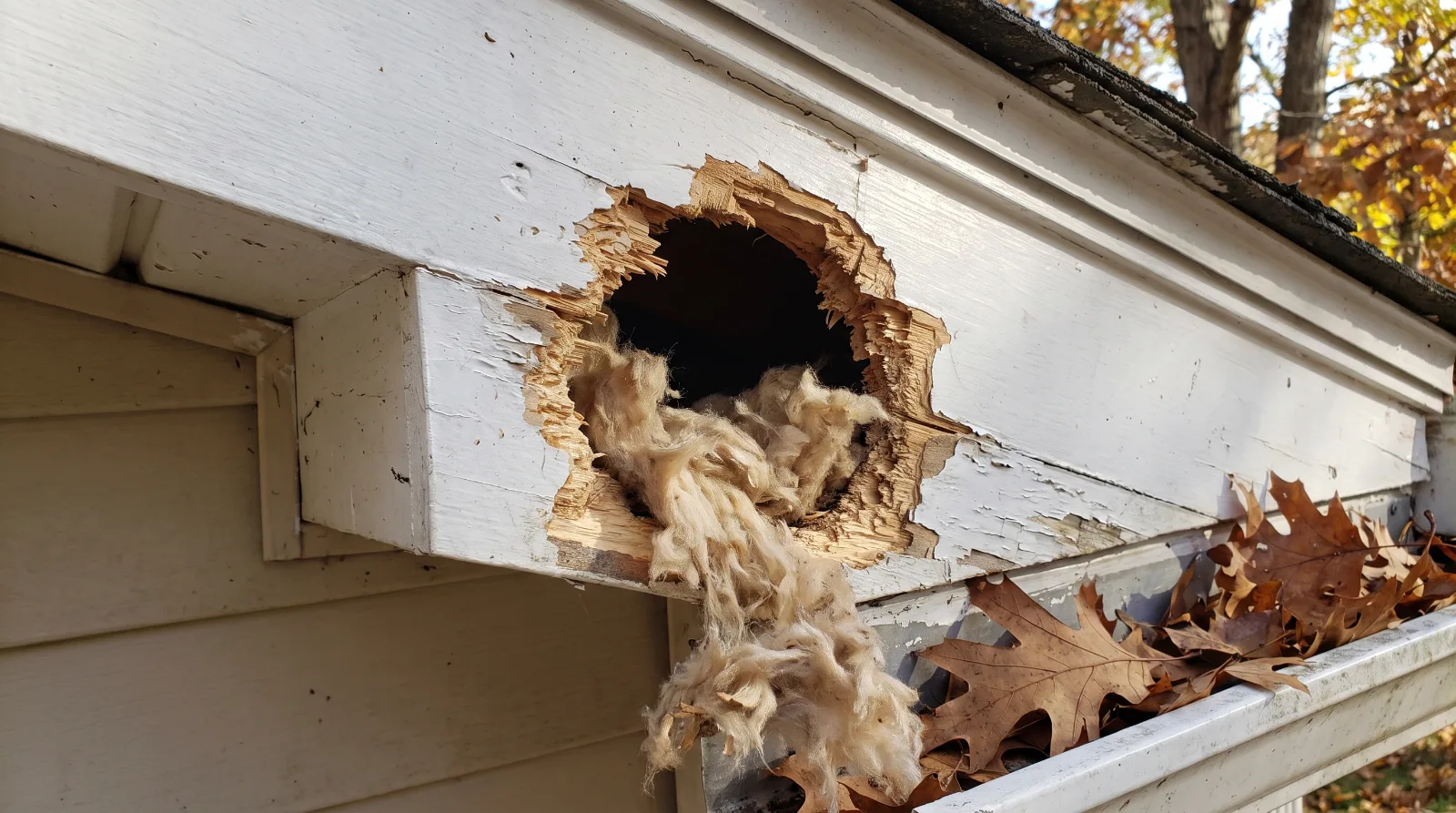
Squirrels rarely make a hole from scratch in sound material. They find a soft spot, a gap or a piece of rotted trim, and they enlarge it. That’s why squirrel damage and roof maintenance problems usually show up together.
- Roof returns and soffit corners. The spot where a lower roof meets a wall, or where the soffit turns a corner, often has a small gap behind the fascia board. It’s one of the most common entry points on any house.
- Gable vents. Thin aluminum or plastic louvers with a flimsy screen behind them. A squirrel can push through in an afternoon.
- Rotted fascia and soffit boards. Wood that has been soaked by overflowing gutters or ice dams goes soft, and soft wood is easy to chew.
- Ridge vent ends. The open ends of a ridge vent, or a ridge vent without an internal baffle, leave a gap at the peak.
- Plumbing vent boots and roof vents. Squirrels chew rubber pipe boots and plastic box vents, which turns a pest problem into a roof leak.
- Chimney chases and gaps around the chimney. Especially where the step flashing has pulled away from the brick.
If you see one hole, assume there’s a second. Closing only the obvious one tends to push the squirrels to chew their way out somewhere else, usually through something more expensive.
How to get squirrels out of your attic legally in Pennsylvania
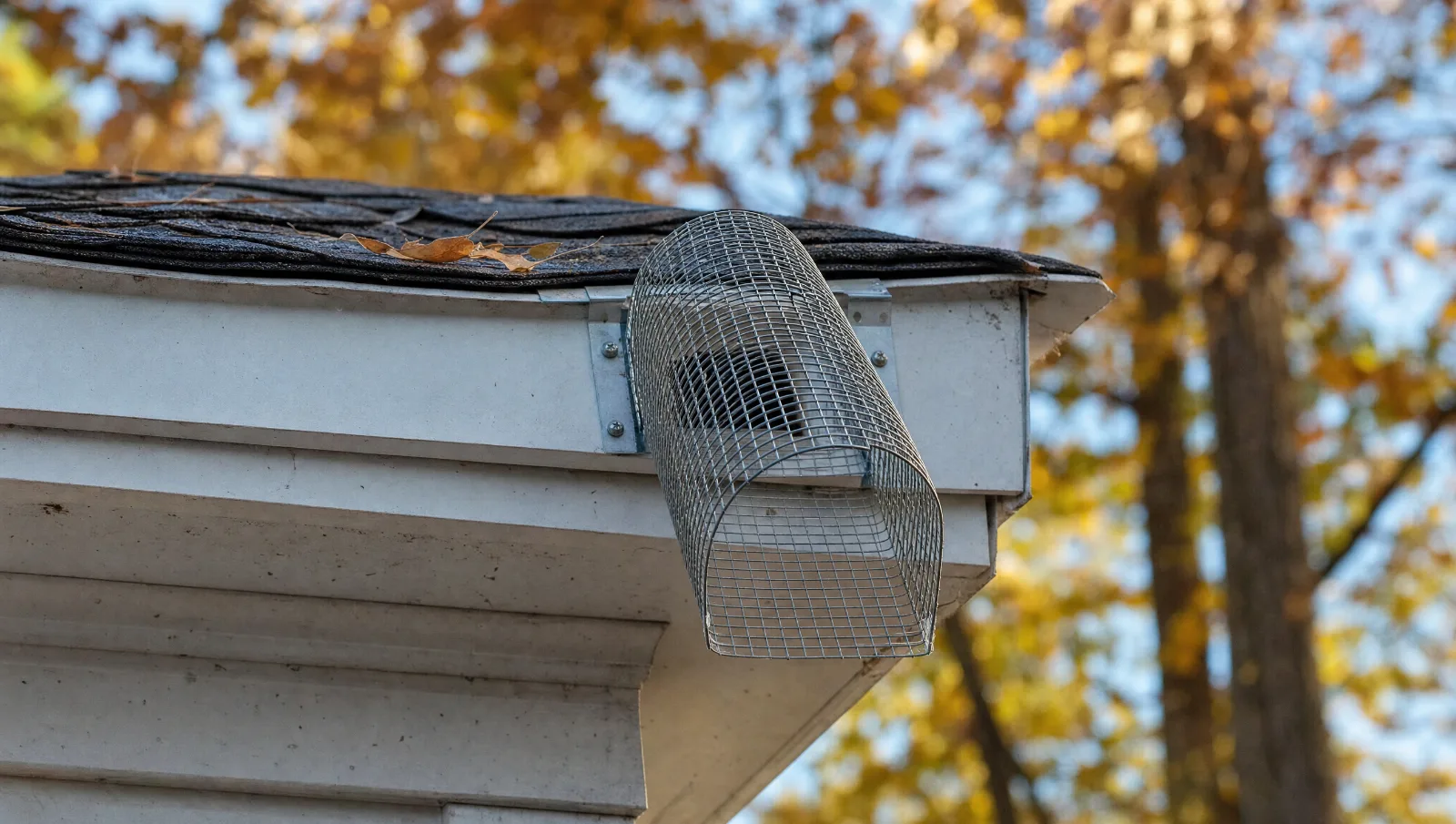
Pennsylvania rules are more flexible for squirrels than for raccoons or bats, but there are still rules. The Game Commission’s nuisance wildlife guidance says squirrels caught in live traps may be relocated to a natural setting, that traps must be checked every day, and that live wildlife can’t be kept, sold or given away. It also asks landowners to contact the Game Commission region office for their county before trapping. Any animal killed has to be reported.
In practice, most attic squirrel jobs are handled with an exclusion door: a one-way mesh tunnel mounted over the main entry hole. Squirrels leave to feed and can’t get back in. Penn State Extension recommends the same approach, and adds the warning that matters most: don’t lock squirrels inside. A trapped squirrel will chew through whatever it has to, including your ceiling drywall or the wiring.
That’s also why timing matters in the fall. A late-summer litter can still be in the nest in September and early October. If you’re not sure the young are out, a wildlife professional will wait or check before the last hole is sealed.
What squirrel removal costs
| Service | Typical cost |
|---|---|
| Inspection to find entry points | $125 – $250 |
| One-way exclusion door (each) | $225 – $400 |
| Trap and relocate | $300 – $600 |
| Full attic removal, cleanup and sealing | $500 – $1,500 |
| Complete eviction plan with guarantee | $1,400 – $4,000 |
National averages from HomeGuide’s 2026 squirrel removal cost data. Wildlife removal is its own trade. Where a roofer comes in is the part those numbers don’t cover well: rebuilding the roofline so it stays closed.
Repairing squirrel damage so they can’t come back
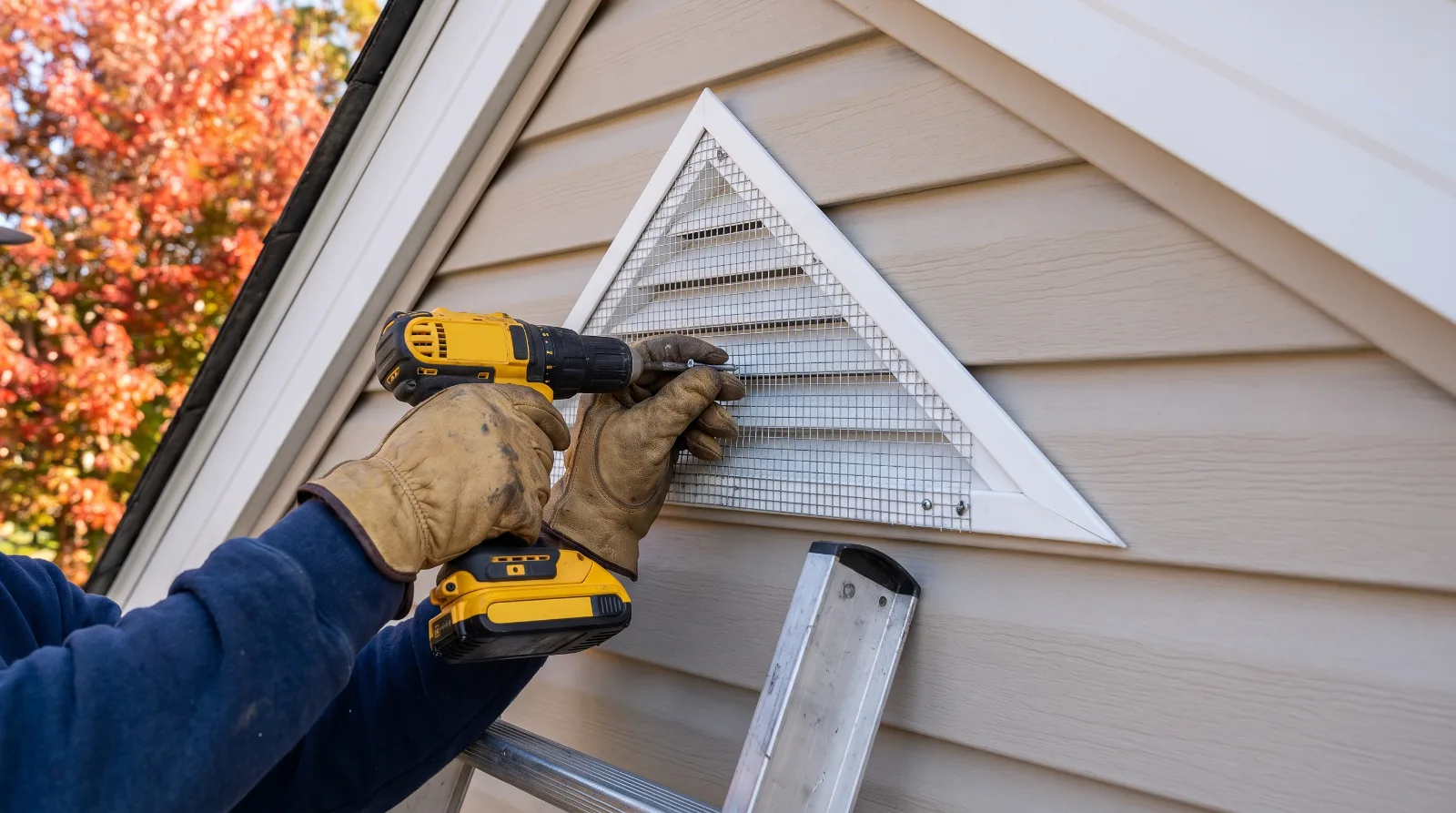
Stuffing a hole with steel wool or spraying foam into it doesn’t last. Squirrels chew foam like it’s bread, and steel wool rusts and falls out in a season. A lasting repair replaces or reinforces the material they got through:
- Replace rotted fascia and soffit with sound wood or wrapped trim. If the wood was soft enough to chew, it was soft enough to fail anyway.
- Screen gable and soffit vents from inside or outside with heavy galvanized mesh. Penn State Extension specifies half-inch wire mesh, which keeps squirrels out without blocking airflow.
- Close roof-return gaps with metal flashing bent to the shape of the corner, not caulk.
- Replace chewed pipe boots and vents with metal or reinforced versions.
- Trim branches back at least 6 to 8 feet from the roof. It’s the cheapest fix on this list.
Here’s what those repairs typically run, per HomeGuide: small roof hole $150 to $1,000, soffit and fascia replacement $9 to $34 per linear foot, drip edge replacement $5 to $9 per linear foot, and replacing contaminated attic insulation $2 to $6 per square foot. If the squirrels chewed a pipe boot and water has been getting in, see our guide to roof leak repair cost in PA.
Honest advice: if the damage is limited to one screened gable vent, a handy homeowner can fix it in an afternoon from a ladder. Call a roofer when the hole is at a roof edge, when the fascia is soft, or when the entry point is anywhere you’d have to walk on the roof to reach.
Chewed fascia and soffit fall under our siding, soffit and fascia work in Stroudsburg. Holes in the roof itself, chewed vents and damaged flashing are roof repair.
Frequently asked questions
Will squirrels leave the attic on their own?
Not in the fall. They’re moving in for the winter, not passing through. In spring they may leave to nest elsewhere, but the hole stays open for the next animal.
Does homeowners insurance cover squirrel damage?
Usually not. Most policies exclude damage caused by rodents and vermin as a maintenance issue. A leak that follows the damage may be treated differently, so read the exclusions and ask your agent before you assume either way.
Can squirrels cause a roof leak?
Yes. Chewed pipe boots, plastic vents and the edges of shingles around an entry hole all let water in. A roof leak that appears in the same season as squirrel noise is rarely a coincidence.
Are squirrels in the attic a fire risk?
They can be. Penn State Extension notes squirrels damage insulation and the insulation around wires. Chewed wiring is a real concern, and it’s a job for a licensed electrician, not a roofer.
When is the best time to squirrel-proof a roof?
Late summer, before they move in, or late fall once you’re sure every animal is out. Either way, get it done before the first snow, when working at the roof edge gets harder.
Close up the roofline before winter
Once the squirrels are out, we’ll walk the whole roofline, find every entry point, not just the obvious one, and give you a written price to close it properly. If there’s rotted trim or a chewed vent letting water in, you’ll know before the snow does. The inspection is free.
Call (570) 426-3505. We work across Stroudsburg, East Stroudsburg, Bushkill, Dingmans Ferry, Milford and the rest of Monroe and Pike County.




One Comment