Professional Siding Installation in the Lehigh Valley: A Homeowner’s Guide
Your home’s exterior is the only thing standing between your family and the Lehigh Valley’s unpredictable weather. It is a critical shield that must handle extreme thermal expansion and moisture year after year. If you’re noticing drafty rooms or fading boards, you’re likely looking for a professional siding installation Lehigh Valley service that delivers more than just a fresh look. You want a solution that lowers your energy bills and stands the test of time.
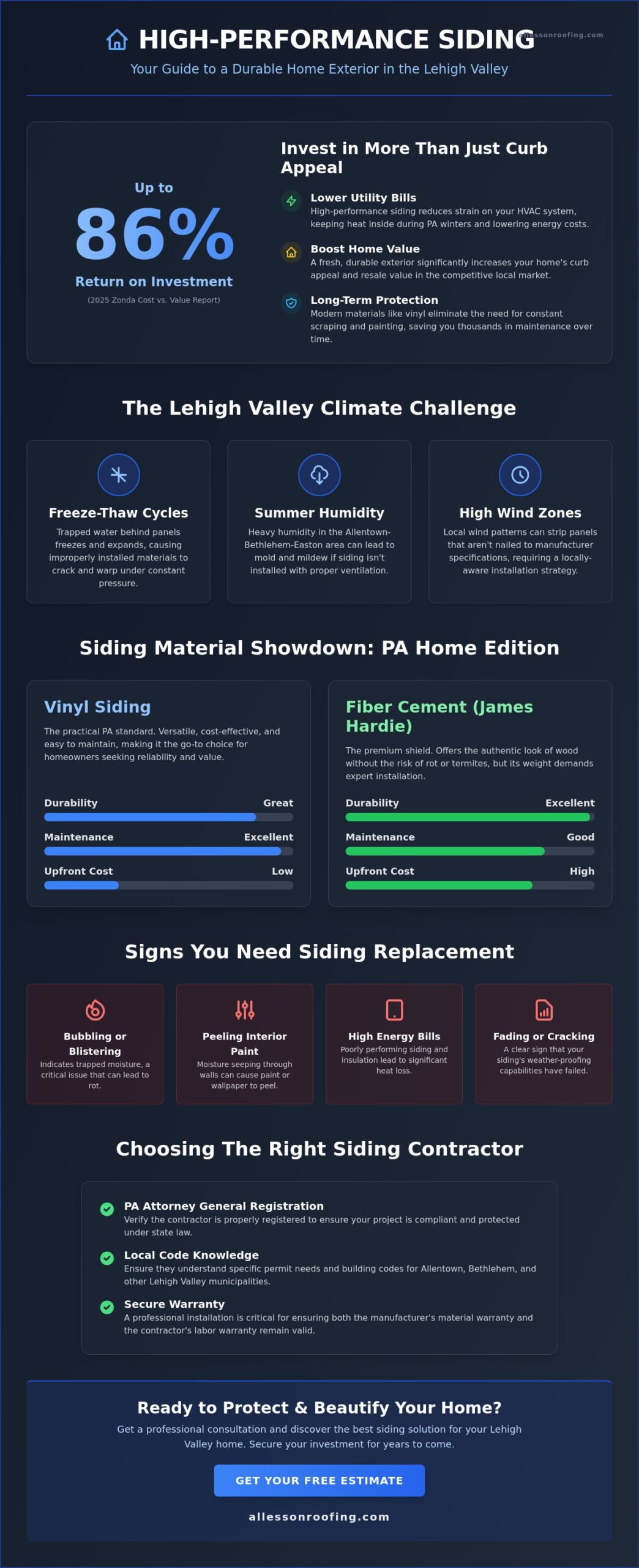
We understand the hesitation that comes with a major exterior project. It’s common to feel overwhelmed by material choices or worried about whether a contractor is properly registered with the Pennsylvania Attorney General’s Office. This guide covers everything you need to know about choosing, installing, and maintaining high-performance siding. We’ll explore why certain materials offer a return on investment as high as 86 percent according to the 2025 Zonda Cost vs. Value report. You’ll also learn about specific permit needs in Allentown and Bethlehem so you can move forward with confidence and peace of mind.
Key Takeaways
- Understand how the Lehigh Valley’s unique humidity and temperature shifts dictate the best defensive strategy for your home’s exterior.
- Compare the long-term ROI and performance of different materials to choose the most durable option for the Pennsylvania climate.
- Learn the critical steps of a professional siding installation Lehigh Valley experts use to prevent mold and rot from hiding behind your boards.
- Spot the specific visual and internal cues, like bubbling paint or peeling wallpaper, that signal your home is ready for a siding upgrade.
- Get a checklist for verifying local contractor credentials to ensure your warranty and service remain secure for years to come.
Why Siding Installation in the Lehigh Valley Requires a Local Strategy
Choosing the right exterior for your home is about more than just picking a color you like. In Pennsylvania, your siding acts as the primary defense against extreme temperature shifts that can swing fifty degrees in a single week. A professional siding installation Lehigh Valley homeowners can trust requires a strategy tailored to our specific zip codes. You might wonder, what is siding exactly in the context of a PA winter? It’s a weather-shield that must be engineered for thermal expansion. While national brands offer great products, they often fail when installed by contractors who don’t understand our local wind patterns or humidity levels. We see it often: beautiful materials ruined by a lack of local insight.
The Lehigh Valley Climate Challenge
Our region faces a unique set of environmental stressors. During the winter, the freeze-thaw cycle is a constant threat to your home’s structural integrity. Water gets trapped behind poorly installed panels, freezes, and expands, causing cheap materials to crack or warp. In the summer, the heavy humidity in the Allentown-Bethlehem-Easton area can lead to mold and mildew if your home isn’t properly ventilated. Have you ever seen siding that looks like it’s “bubbling” in the heat? That’s often a sign of poor thermal expansion management. Additionally, local wind patterns can easily strip panels that weren’t nailed according to manufacturer specifications for our high-wind zones. Proper installation ensures each panel has the “room to breathe” it needs to survive these shifts.
The ROI of High-Quality Exterior Cladding
Investing in premium siding does more than just make your house look better. It’s a financial decision that pays off in lower utility bills. High-performance siding reduces the strain on your HVAC system during those biting PA winters, keeping your heat inside where it belongs. In Northampton and Lehigh counties, curb appeal is directly tied to resale value. According to the 2025 Cost vs. Value report, replacing siding can return up to 86 percent of your investment. When you invest in a professional siding installation Lehigh Valley project, you’re not just buying materials; you’re securing your home’s future market value. Many homeowners are moving toward maintenance-free vinyl because it eliminates the constant scraping and painting required by traditional wood, saving you thousands of dollars over the life of the home. This shift toward durable, low-maintenance materials is a smart play for any homeowner looking to maximize their property’s potential.
Comparing Siding Materials: Which is Best for Your PA Home?
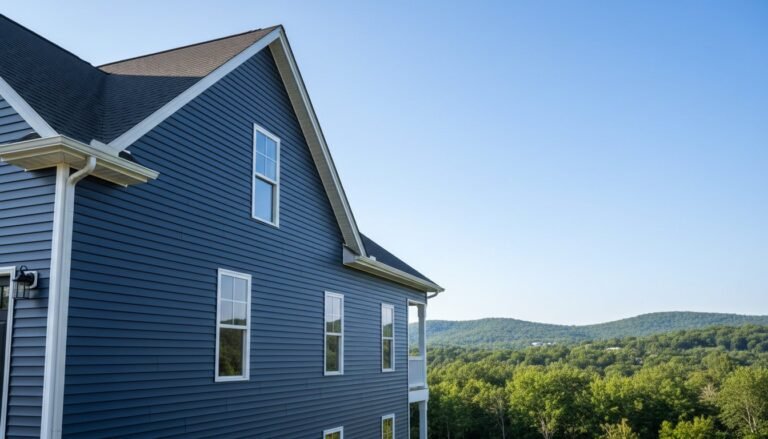
Selecting a material for your home’s exterior is a long-term commitment. In the Lehigh Valley, East Stroudsburg, and throughout Northampton and Lehigh counties, homeowners often feel torn between the affordability of vinyl and the premium feel of fiber cement. To help you decide, we’ve put together a Best Siding for PA Homes: 2026 Guide to Durability and Style that dives deep into these options. Whether you prefer the timeless look of Dutch lap or the modern appeal of vertical board and batten, your choice should reflect both your style and your budget. It’s not just about the upfront cost; you have to consider how well the material will hold up against our local humidity and shifting seasons.
Vinyl Siding: The Practical PA Standard
Vinyl siding remains the practical standard for a reason. It’s incredibly versatile and easy to maintain. For many older homes in our area, insulated vinyl is a game-changer. It adds a layer of thermal protection that helps keep those drafty winter winds at bay. Modern vinyl also features improved UV resistance, so those deep colors won’t fade as quickly. Before committing to a material, it’s worth reviewing a detailed breakdown of the cost to install vinyl siding in the Poconos and Lehigh Valley so you can budget accurately and avoid hidden fees. This is often the go-to choice for a siding installation Lehigh Valley homeowners trust.
Fiber Cement (James Hardie): The Premium Shield
If you’re looking for a premium shield, fiber cement is the gold standard. It offers the authentic look of wood without the risk of rot or termite damage common in Pennsylvania. Because of its weight, this material demands expert handling. A Professional Siding Installation ensures that the moisture management systems behind these heavy panels are correctly configured to prevent trapped water.
Every neighborhood has its own character. A classic colonial in Allentown might look best with traditional lap siding, while a modern farmhouse in Bethlehem could benefit from a mixed-material approach. No matter which material you choose, the success of the project relies on the quality of the workmanship. Choosing a local expert who understands these nuances makes a world of difference in the final result. If you’re ready to upgrade your home’s exterior and want a partner you can trust, we’re ready to discuss your next siding installation Lehigh Valley project. We take quiet pride in our craftsmanship and local roots.
The Anatomy of a Professional Siding Installation
A successful project isn’t just about how the panels look on day one. It’s about what happens behind the material. When we perform a siding installation Lehigh Valley homeowners can rely on, we follow a methodical five-step process designed to protect your home’s structural integrity. Many contractors skip the “invisible” steps, but these are exactly what prevent long-term rot and high energy bills. If you want to avoid future headaches, you need to know what a correct installation looks like from the inside out.
- Step 1: Complete Removal and Inspection. We strip away the old material to see the true state of your home’s exterior walls. This is the only way to find hidden issues.
- Step 2: Substrate Repair. If we find rot, mold, or insect damage, we fix it immediately. Putting new siding over failing wood is a recipe for disaster.
- Step 3: Precision Flashing. We install custom-fit shields around windows, doors, and roof intersections. This ensures water is directed away from your frame, not into it.
- Step 4: Engineered Fastening. We use specific nailing patterns that allow the siding to slide horizontally as it reacts to the weather.
- Step 5: Final Quality Walkthrough. We seal every joint and perform a ground-level inspection to ensure every detail meets our standards.
The Importance of the House Wrap and Barrier
Think of house wrap as your home’s raincoat. This layer sits directly against your wood framing and serves as the ultimate moisture defense. In our Pennsylvania climate, we use breathable wraps that let interior moisture escape while blocking exterior rain. A major red flag to watch for is a contractor who reuses old, torn wrap or omits it entirely. Without a fresh, high-quality barrier, trapped humidity can lead to hidden structural rot that you won’t see until it’s too late. Check your project: is the wrap taped at every single seam? If not, it’s not truly weather-tight.
Thermal Expansion: Why “Loose” Nailing is Correct
Siding panels are designed to move. In the Lehigh Valley, temperatures can swing from below zero in January to nearly 100 degrees in July. As the temperature rises, vinyl and fiber cement panels physically grow in length. If an installer drives nails too tight against the panel, the material has nowhere to go. This leads to buckling, wavy lines, and panels that eventually pop off the wall. You can test this yourself. After a professional siding installation Lehigh Valley project, you should be able to slide a panel slightly left or right with your hand. If it’s pinned solid, it’s a technical error that will cause damage later. We take pride in this technical precision because it’s the difference between a job that lasts ten years and one that lasts fifty.
Signs You Need Siding Replacement vs. Simple Repair
How do you know when a few quick fixes aren’t enough to protect your home? Deciding between a patch job and a full siding installation Lehigh Valley project often comes down to the severity of the damage and its location. While a single cracked panel from a stray baseball is an easy fix, widespread issues usually point to a failure in the system’s integrity. If you ignore these signs, you risk moisture seeping into your wall studs, leading to expensive structural repairs. It’s often helpful to look at your home’s exterior and interior as a connected unit. For instance, a failing roof can often mimic siding issues. You can learn more about how your roof protects your home in our guide to Expert Asphalt Shingle Installation in PA: The Homeowner’s Guide.
Start your inspection by looking for visual “red flags” on your exterior walls. Bubbling or blistering on the surface of your siding is a major concern; it often means moisture is trapped inside the panel or that the material has succumbed to extreme heat. Warping and wavy lines are also common in our region, usually resulting from the tight-nailing issues we discussed earlier. Inside your home, keep an eye out for peeling wallpaper or persistent mold growth on walls that face the outdoors. These aren’t just cosmetic problems. They are clear signals that your exterior shield has been breached. If your heating and cooling costs have spiked despite a well-maintained HVAC system, your siding may no longer provide the insulation your home needs.
The “Fascia and Soffit” Connection
Your siding doesn’t exist in a vacuum. It works alongside your roofline, gutters, and ventilation systems to keep your home dry. We often find that damaged siding panels hide underlying issues with fascia and soffit boards, which are critical for attic ventilation. In the Poconos and surrounding areas, severe weather can accelerate this wear. If you’ve recently experienced a heavy storm, it’s wise to check both your siding and your roof for impact damage. For urgent situations, our Emergency Roof Repair Poconos: The Homeowner’s 24/7 Response Guide provides a clear path for immediate action.
When Repair is No Longer Cost-Effective
At a certain point, piecemeal repairs become a game of diminishing returns. One of the biggest challenges with older siding is color matching. Because Pennsylvania sun exposure fades panels over time, new “matching” pieces will often stand out as bright, obvious patches. More importantly, partial replacements can compromise the continuous moisture barrier we talked about in the installation anatomy section. When you replace a full wall or the entire house, you ensure the house wrap and flashing are seamless and functional. If you’re tired of temporary fixes and want a permanent solution, we’re here to help you plan a professional siding installation Lehigh Valley that restores your home’s beauty and efficiency.
Choosing the Right Lehigh Valley Siding Contractor
Finding a contractor who knows the difference between Allentown’s building codes and Bethlehem Township’s requirements is the final step in securing your home. A professional siding installation Lehigh Valley homeowners can rely on starts with transparency and local accountability. We recommend verifying that any contractor you consider is registered with the Pennsylvania Attorney General’s Office. In our state, any contractor performing more than $5,000 of work per year must register and maintain at least $50,000 in personal injury and property damage insurance. These aren’t just suggestions; they are the baseline for protecting your property during a major renovation.
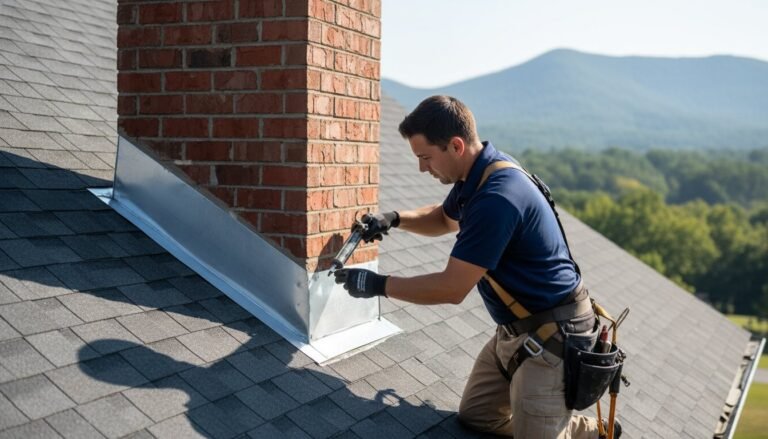
At Allesson Roofing, we focus on what we call the “Envelope approach.” This means we don’t view your walls and roof as separate systems. Instead, we look at how your chimney flashing, roofline, and siding work together to shed water. A properly sealed home also depends on a reliable chimney flashing repair service to prevent water intrusion at one of the most vulnerable points on your roof. When you ask for references, make sure you’re looking at siding projects specifically. A company might be great at shingles but struggle with the intricate flashing required for a high-quality siding installation. Always insist on a written, itemized estimate. This document should clearly outline the cost of materials, labor, and waste disposal so there are no surprises when the job is done.
Local Knowledge vs. National Franchises
National franchises often use 1-800 numbers and high-pressure sales reps who have never set foot in Northampton or Lehigh counties. A local contractor understands that the City of Allentown requires a non-refundable $50 application fee for residential building permits, while Bethlehem Township doesn’t require a permit for siding at all. If you live in a historic district like parts of Easton, you may even need a “certificate of appropriateness” before work begins. Working with a neighbor means you get direct communication without a middleman. We live where we work, and we take quiet pride in maintaining the homes in our own community. If you’re also evaluating contractors for work in the Poconos region, our detailed guide on hiring the best East Stroudsburg siding companies for siding repair East Stroudsburg homeowners can trust walks you through the complete 2026 vetting checklist, including state registration verification and local permit requirements.
Questions to Ask During Your Consultation
Before you sign a contract, have a straightforward conversation about the “what-ifs.” Ask your contractor how they handle hidden rot or mold found during the tear-off process. A dependable professional will have a clear protocol for substrate repair rather than just covering it up. You should also ask about the specific brand and grade of material they recommend for our climate. Finally, verify the warranty details. While manufacturers cover the materials, you want to ensure your contractor provides a separate labor warranty to cover the craftsmanship itself. If you’re ready to start your project with a team that values transparency, we’re here to provide the steady, professional guidance you need for a successful siding installation Lehigh Valley.
Secure Your Home’s Future with a Local Expert
Your home deserves an exterior that can withstand the unique challenges of our Pennsylvania climate. By choosing a local strategy and understanding the technical steps of a professional installation, you’re doing more than just improving curb appeal. You’re ensuring your home remains energy-efficient and structurally sound for decades. Remember that a successful siding installation Lehigh Valley project relies on the “envelope approach,” where the roof and walls work together as a single, weather-tight system.
At Allesson Roofing, we bring years of expertise in both roofing and siding to every project we handle. We are locally owned and operated right here in East Stroudsburg, and we take pride in providing no-nonsense, professional service with transparent pricing. If you’re ready to upgrade your exterior with a partner you can trust, we’re here to help. Get Your Free Lehigh Valley Siding Estimate from Allesson Roofing today. We look forward to helping you protect your home and your investment with craftsmanship you can rely on.
Frequently Asked Questions
How much does siding installation cost in the Lehigh Valley?
The total cost of your project depends on the material you choose, the square footage of your home, and the complexity of the architecture. You should always request a detailed, itemized estimate that includes the removal of old materials and disposal fees. This ensures you understand exactly what you’re paying for without any hidden surprises later on.
How long does it take to install new siding on a standard home?
A typical siding project usually takes between one and two weeks to complete from start to finish. This timeline accounts for the initial tear-off, any necessary substrate repairs, and the precise installation of your new panels and flashing. Local weather conditions in Pennsylvania can sometimes shift this schedule, but we work efficiently to minimize the disruption to your daily routine.
Can I install new siding over my old siding to save money?
While some suggest a “lay-over” to save on labor, we strongly recommend a full tear-off for every siding installation Lehigh Valley project. Installing new material over the old hides existing rot, mold, and insect damage that will continue to spread. Starting with a clean, inspected substrate is the only way to ensure your home’s structural integrity is protected for the long term.
What is the most durable siding for Pennsylvania weather?
Fiber cement is often cited as the most durable option because it resists rot, fire, and impact damage from hail. However, modern high-grade vinyl is also an excellent choice for our climate. It handles the Lehigh Valley’s extreme temperature swings well and requires very little maintenance to keep its original look and strength over the years.
Does new siding really improve energy efficiency?
Yes, especially when you pair high-quality materials with an insulated backing or a professional-grade house wrap. These layers create a thermal break that prevents heat from escaping through your wall studs during cold PA winters. Many homeowners notice a visible difference in their monthly utility bills after upgrading to a modern, well-sealed exterior system.
How often should I wash or maintain my vinyl siding?
You should aim to wash your siding at least once a year using a soft-bristle brush and a mild cleaning solution. This simple task removes dirt, pollen, and organic growth that can dull the finish over time. Regular inspections in the spring and fall also help you spot small issues like loose panels before they turn into expensive repairs.
What happens if my siding is damaged by a storm in the Poconos?
You should act quickly to have a professional inspect the area and prevent moisture from reaching your home’s interior framing. We provide emergency storm damage restoration to help homeowners secure their property after severe weather events. Prompt repairs are essential to maintaining your home’s weather-tight seal and preventing long-term water damage or mold growth.
Is fiber cement siding worth the extra cost over vinyl?
Fiber cement is worth the investment if you want a premium, wood-like aesthetic with superior fire and impact resistance. It often carries a higher return on investment in the local real estate market due to its longevity. While vinyl remains a popular and budget-friendly standard, fiber cement offers a level of durability that many Lehigh Valley homeowners find valuable for their “forever” homes.