What Happens If It Rains During Your Roof Replacement
The crew tore off half your roof this morning, and now there’s a thunderstorm on the radar for 4 p.m. So what happens if it rains during your roof replacement?
On a properly run job, nothing happens to your house. Before the crew walks off the roof — for lunch, for the night, or because the sky turned — the deck is dried in. That means it’s covered and sealed, and water runs off it the same way it runs off a finished roof. The shingles are the last layer, not the waterproof one.
Rain is a scheduling problem for us. It should never be a water problem for you.
The short answer: your deck is never left open to the sky
If rain arrives mid-job, the exposed deck is already covered with underlayment and sealed membrane, so water sheds off it just like a finished roof. The only vulnerable window is the few hours a section is stripped and not yet covered — and that window is planned around the forecast, not ignored.
That’s the whole answer. Everything below is how it’s actually done, and what you should be able to see from your own driveway.
What “dry-in” actually means
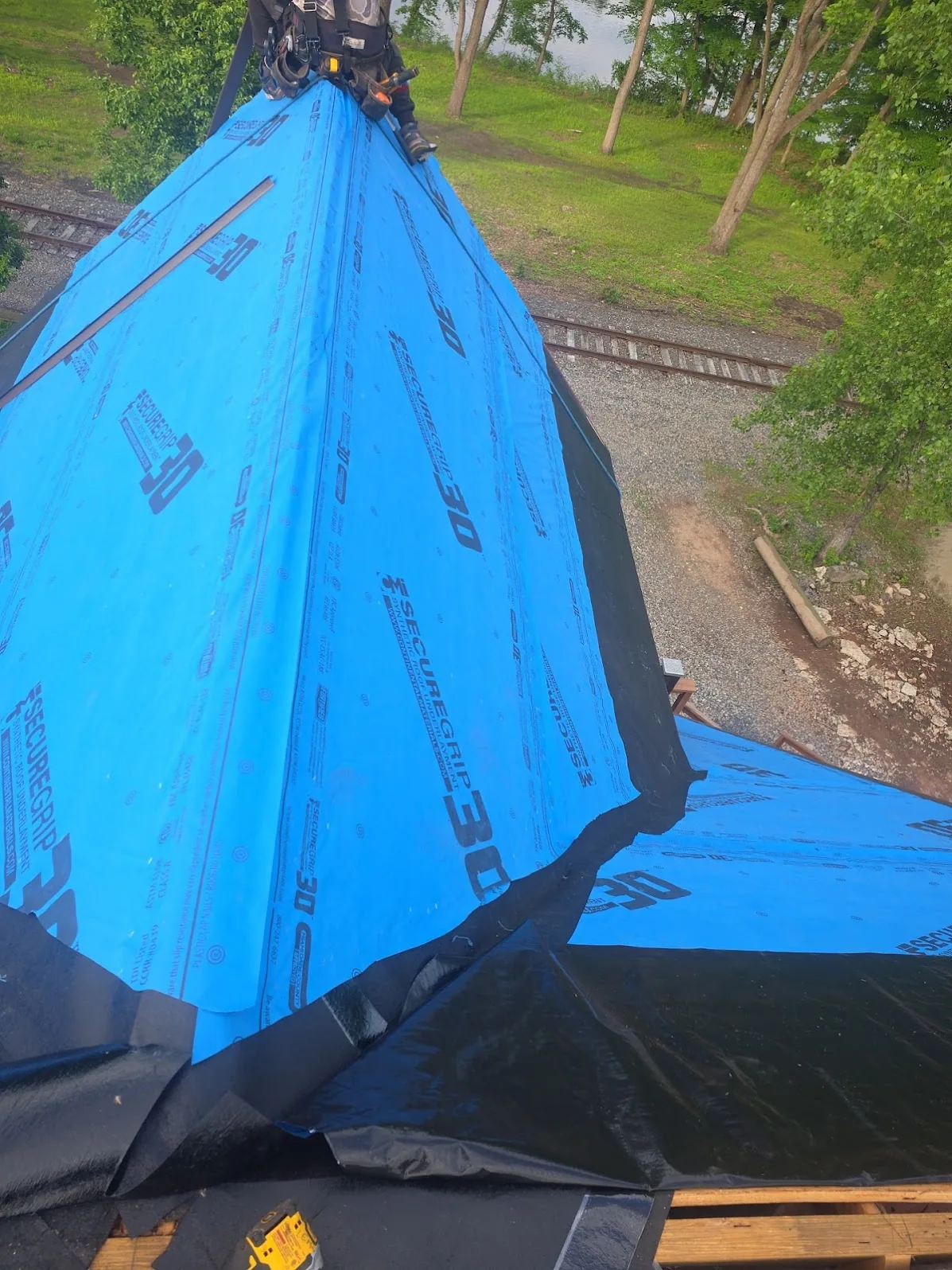
“Dry-in” is the point in the job where your roof is watertight without a single shingle on it.
The field gets synthetic underlayment. Not old felt paper, which wrinkles and tears once it gets wet. The synthetic underlayment on our jobs is rated by its manufacturer for up to 90 days of UV exposure, tested to ICC-AC-207. Read that number again: the layer under your shingles is engineered to sit out in the weather for three months. An overnight storm is not what it’s worried about.
The eaves and valleys get ice-and-water membrane. This is the self-adhering stuff — a rubberized asphalt sheet that sticks directly to the deck and seals around the shank of every nail driven through it. That self-sealing property is exactly why it goes where water concentrates and where ice backs up.
The edges get closed. Drip edge along the eaves and rakes, underlayment lapped shingle-fashion so every upper course sheds onto the one below, and open penetrations covered.
What dry-in is not: a tarp thrown over the roof and weighted with a bundle of shingles. Tarps have their place — they’re for storm damage and emergency roof response, when there’s no time to do anything else. A tarp is not a plan for a scheduled replacement.
Why we never tear off more than we can close the same day
Here’s the rule the whole job runs on: you only open what you can close.
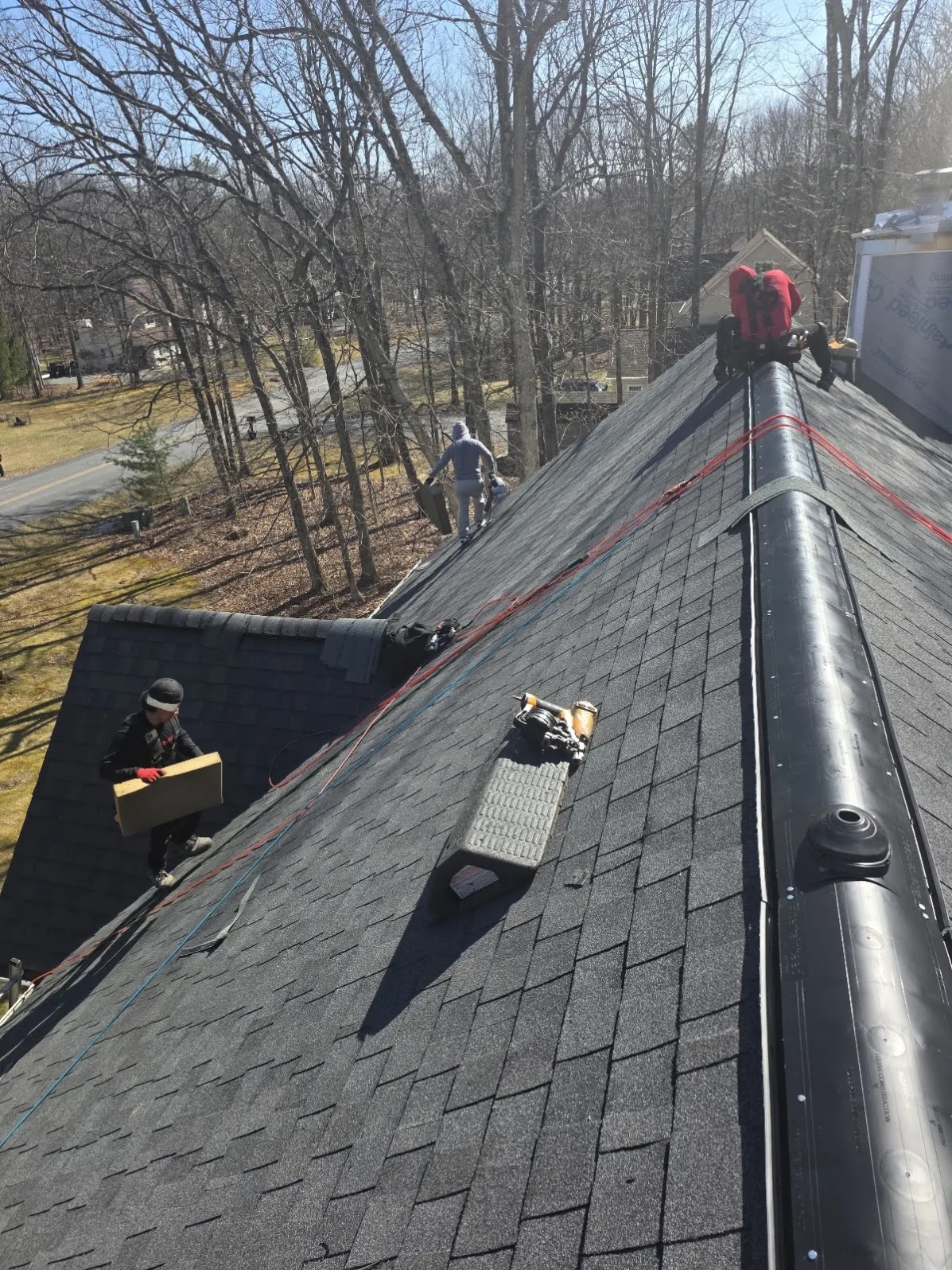
The crew doesn’t strip the entire house on Monday morning and start shingling Tuesday. The roof comes off in sections, and the size of the section is set by two things — how big the roof is and how many people are on it. A three-person crew closes a certain amount of roof in a day. So that’s how much gets opened that day. Not more.
Weather doesn’t change that math, it just tightens it. If the forecast says 3 p.m. storms, the morning tear-off is scoped to be dried in by 2. What we care about is that the roof is closed when we leave it, so that rain overnight or a storm the next day doesn’t cost us — or you — a single day of progress.
The honest consequence: sometimes this makes a job take an extra day, and we’d rather tell you that up front. A crew that opens the whole roof to “move faster” isn’t being efficient — they’re betting your ceiling on the forecast. If you want the realistic version of how the days stack up, we broke it down in our guide to how long a roof replacement takes in PA.
What happens when a storm rolls in mid-tear-off
Radar apps changed this job more than most homeowners realize. Here’s the actual sequence when a cell shows up:
- Tear-off stops. Nothing new gets opened. That’s the first decision and it happens early — you don’t wait until you hear thunder.
- The open section gets closed first. Underlayment rolls out over the bare deck and gets fastened down. A section that took two hours to strip can be dried in far faster than that.
- Eaves and valleys in the open area get membrane before the field is covered, because that’s where water will concentrate first.
- Loose debris and nails get cleared so wind doesn’t turn them into projectiles, and the material on the roof gets secured or brought down.
- The crew waits it out. Not on your roof — nobody works a wet roof, and that’s a safety rule before it’s a quality rule.
- Work resumes when the deck is dry to the touch. This is the part people skip past: shingles do not go over damp decking. Nail a roof down over trapped moisture and you’ve built a problem into the assembly that nobody can see for years.
And if some plywood did get wet? Sheathing that got rained on dries out fine. Sheathing that’s saturated and delaminating gets cut out and replaced — that’s a decision made with you, not around you.
What your roof looks like overnight on a multi-day job
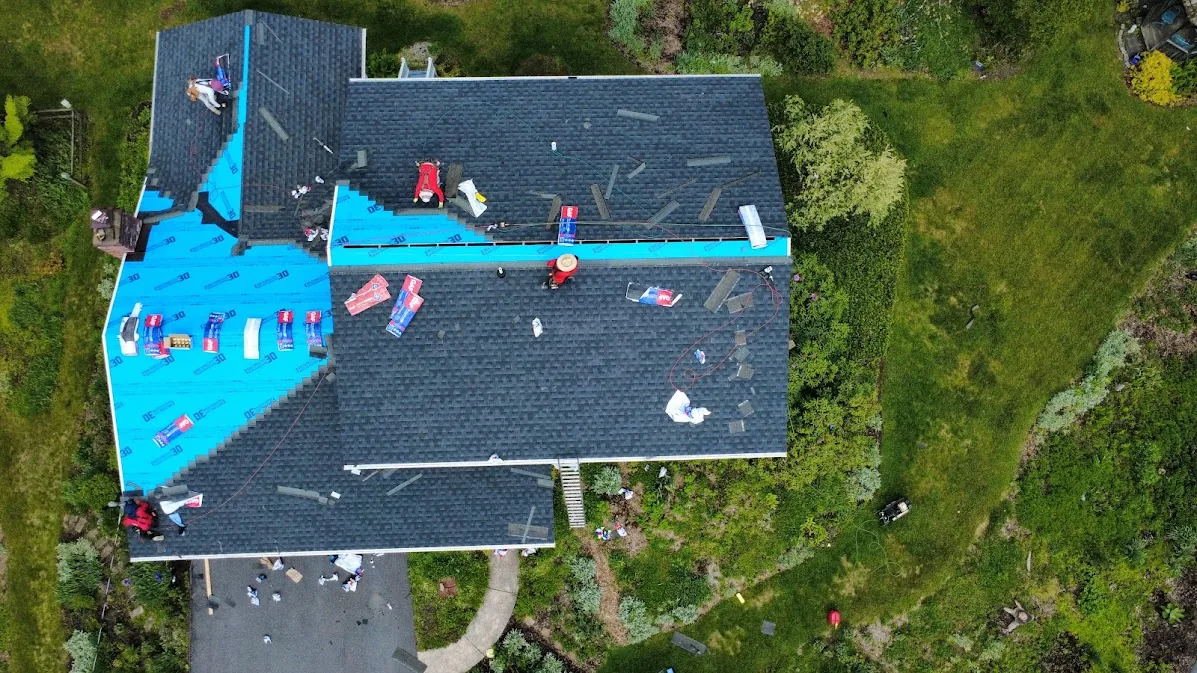
You’ll pull into the driveway at six and your roof will look unfinished. That’s normal. Here’s how to tell “unfinished” from “open.”
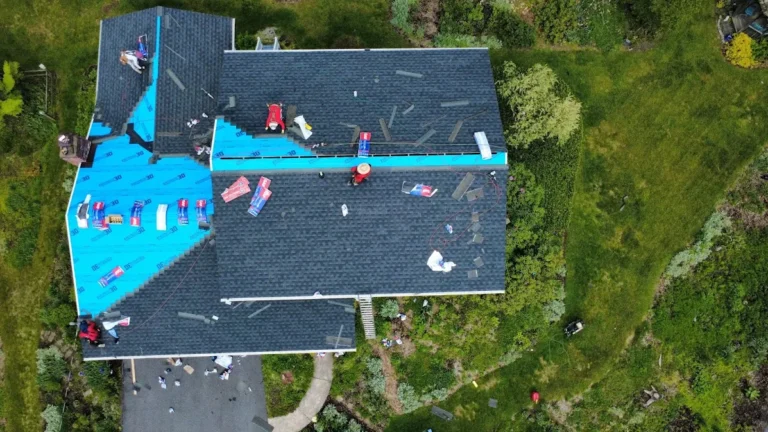
On a two- or three-day job, the roof at the end of day one usually looks like a split screen: one plane or half a plane with new shingles on it, the rest covered in underlayment with the drip edge already on. Material for tomorrow sits on the roof, laid flat and strapped, or stays on the ground. Your yard is tarped and the crew has run a magnet over it.
What you should not see is bare wood. Not a strip along the ridge, not one corner they’ll “get to first thing.” Bare deck at the end of the day is the one thing on this list that isn’t a matter of style — it’s the only condition where a night of rain reaches your insulation and your ceiling.
Poconos weather is why this matters more up here
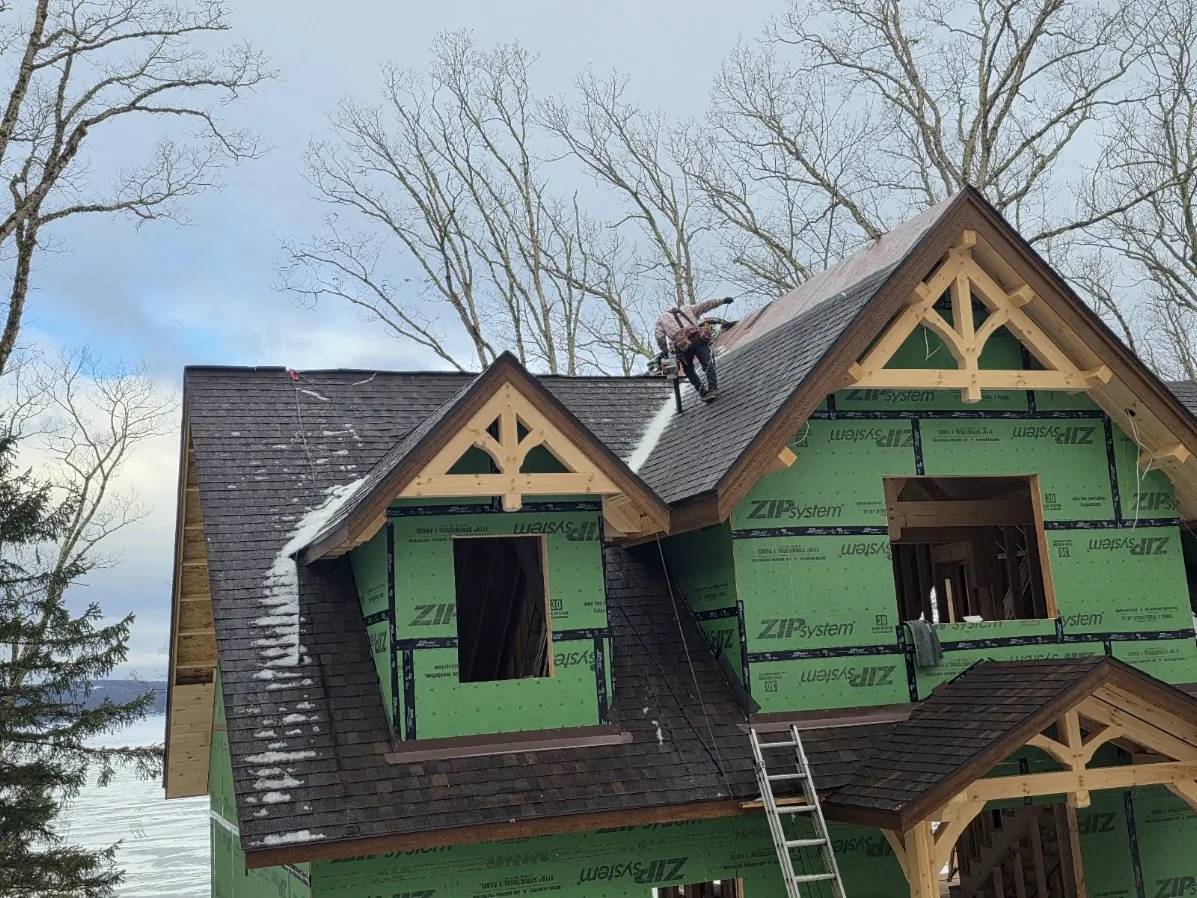
Two local realities shape how our roof installation crews plan a day.
Summer storms don’t announce themselves. Mount Pocono averages around 130 days a year with some kind of precipitation, and a good share of our summer rain comes from pop-up afternoon convection that isn’t on the 7 a.m. forecast at all. That’s why the day’s tear-off plan gets set in the morning and revisited at midday. Anyone who scopes a summer roof here off a single morning forecast hasn’t worked many summers here.
Cold weather changes the material, not just the comfort. Asphalt shingles seal themselves with an adhesive strip that needs sun and warmth to bond. In November and December that bond can take days instead of hours, which is why shingles installed in the cold often get hand-sealed. We do work through the winter — snow on the roof is a normal week in January for us — but the sequencing gets more conservative, because daylight is shorter and there’s simply less time to close what you open.
If you’re still choosing when to book the work, that trade-off is the whole subject of our guide to the best season to schedule the work, and it’s worth reading before you commit to a date on a roof replacement in the Poconos.
Red flags you can spot from the ground
You don’t need to climb a ladder to judge this. At the end of any work day, look up:
- Bare decking visible anywhere. The one true red flag.
- Underlayment flapping in the wind or held down by a handful of fasteners at the corners.
- A tarp doing the job the underlayment should be doing on a planned replacement.
- The whole roof opened at once on a job that clearly can’t be finished today.
- Shingles going down right after a downpour with no drying time in between.
- A shrug when you ask. Any foreman should be able to tell you, in one sentence, how far they’re opening the roof today and when it’ll be closed.
Ask us those questions too. If a crew on your house — ours included — can’t give you a straight answer about how the roof will be left tonight, you’re entitled to push on it before the shovels come out.
Frequently asked questions
Will my roof leak if it rains during the replacement?
It shouldn’t. Once the deck is dried in with underlayment and sealed at the eaves and valleys, it sheds water like a finished roof. Leaks during a replacement come from decking left uncovered, not from the absence of shingles.
Can it rain on roof underlayment?
Yes. Synthetic underlayment is built for it — the product on our jobs is rated for up to 90 days of exposure. It’s a temporary weather surface by design, not a paper layer that has to stay dry.
Do roofers work in the rain?
No. Wet roofs are a fall hazard, and shingles shouldn’t be installed over a damp deck. Crews stop, close what’s open, and come back when the surface is dry — which is usually the same day for a summer shower.
What if my plywood got soaked before the shingles went on?
Sheathing that got rained on and then dried is fine. Sheathing that’s saturated or delaminating gets replaced, and a straight contractor will show you the sheet before it goes in the trailer.
Should I reschedule if rain is in the forecast?
Usually not. A forecast with scattered afternoon storms is a normal working week here from June through August. What matters isn’t whether it rains — it’s whether your crew scopes the day so the roof is closed before it does.
Ask us how we’ll leave your roof tonight
We’ve been replacing roofs across the Poconos for more than a decade, we’re insured, and we’ll hand you the certificates before you sign anything. We’ll also tell you, before we start, how many days your roof will take and how far we’ll open it each morning — because that’s the answer that actually protects your house.
Inspections are free. Call (570) 426-3505 and we’ll come take a look, rain or shine.
— Manuel Lema, Allesson Roofing