Siding Installation & Repair in Stroudsburg, PA

Your siding takes the same beating your roof does — it just takes it from the side. Between the freeze-thaw cycles that run from November through March up here, wind-driven rain coming off the ridges, and the humidity that sits in the Delaware valley all summer, siding in the Poconos ages faster than the brochure promised.

We’re Allesson Roofing & Siding, based on Sarah Way in East Stroudsburg. We install and repair vinyl, insulated vinyl and fiber cement siding across Stroudsburg, East Stroudsburg, Mount Pocono and the rest of Monroe County. Because we’re a roofing crew as well, we catch the failure most siding-only contractors walk past: the point where the wall meets the roof.

Free inspection, straight answer, no pressure. Call (570) 426-3505.

About Our Siding Services in Stroudsburg, PA

Most of our siding work in Stroudsburg falls into four buckets. Full siding replacement, when the panels have reached the end and patching is throwing money at a wall. Section repair, when a storm took out one elevation and the rest is sound. Trim, soffit and fascia work, which is where rot usually starts on a Poconos home because that’s where ice dams push water backward. And storm and impact damage, including the hail that comes through the Lehigh Valley most summers.

Every job includes what’s behind the panels, not just the panels. We check the sheathing for soft spots, replace what’s rotted, and re-lap the house wrap so water that gets past the siding — and some always does — has a path back out. Siding is a drainage system, not a raincoat. Installed as if it were sealed tight, it traps moisture and rots the wall it was supposed to protect.

We also handle the transition details: kick-out flashing where a roof edge dies into a wall, step flashing along a dormer, and the gap at the bottom course that has to stay open so the wall can breathe.
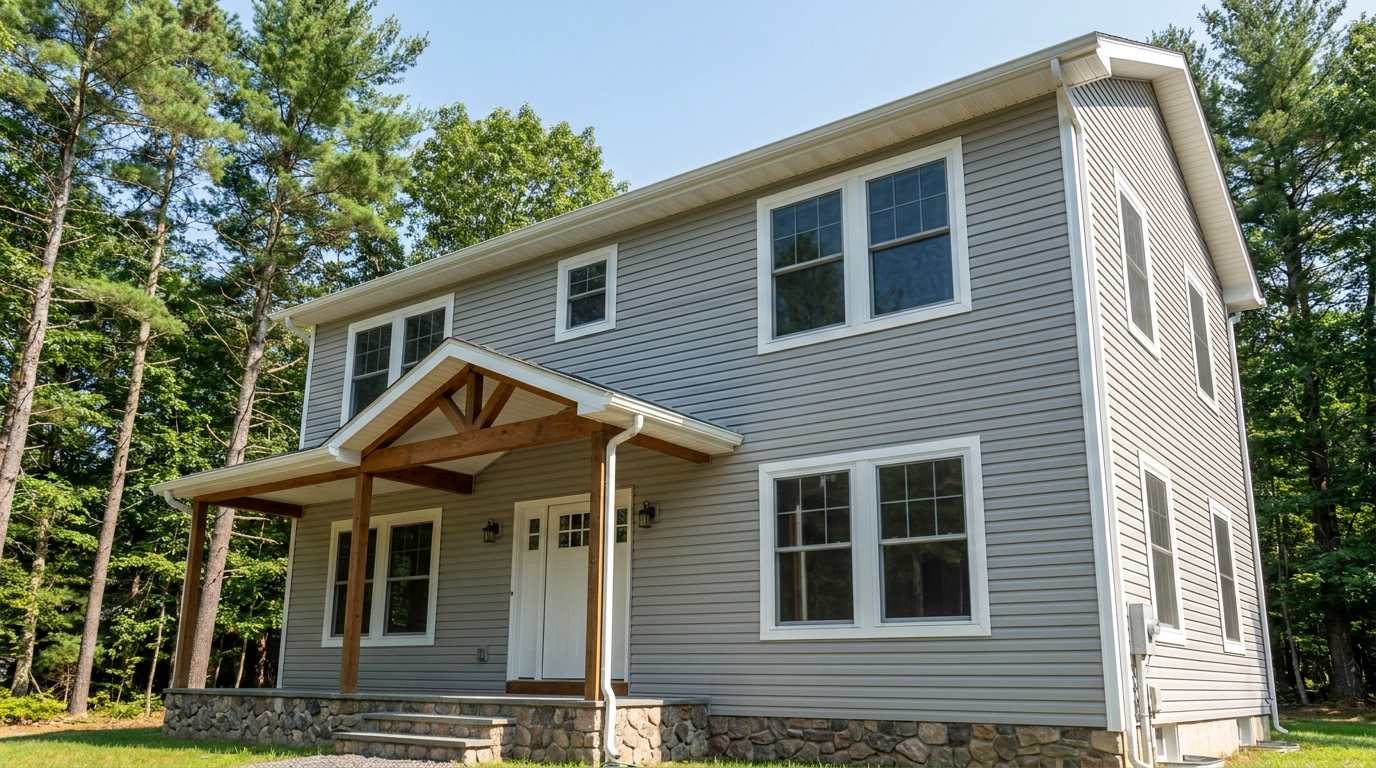
Home in the Poconos with newly installed gray vinyl siding and white trim, siding installation in Stroudsburg PA

Signs You Need New Siding in Stroudsburg

You don’t need a contractor to spot most of these. Walk your house on a bright day and look for:

  • Warped, buckled or wavy panels — usually a sign the siding was nailed too tight and couldn’t expand.
  • Cracks and holes after a hail or wind event, most often on the west and south walls.
  • Chalky residue on your hand after you rub a panel. That’s oxidation; the color is done.
  • Soft spots when you press near the bottom course — that’s the sheathing behind, not the siding, and it means water has been getting in for a while.
  • Mildew or green-black streaking on north-facing walls that keeps coming back after washing.
  • Peeling interior paint or bubbled wallpaper on an exterior wall — moisture is coming through the assembly.
  • Panels that rattle or clatter in a windstorm.
  • Woodpecker holes or carpenter bee tunnels in the trim. Up against the tree line in Bushkill and Dingmans Ferry this is a weekly conversation, not a rare event.
  • Heating bills climbing without a change in habits, especially in a house with no wall insulation upgrade.

One or two of these on an otherwise sound wall is a repair. Four or five across multiple elevations is usually a replacement conversation.
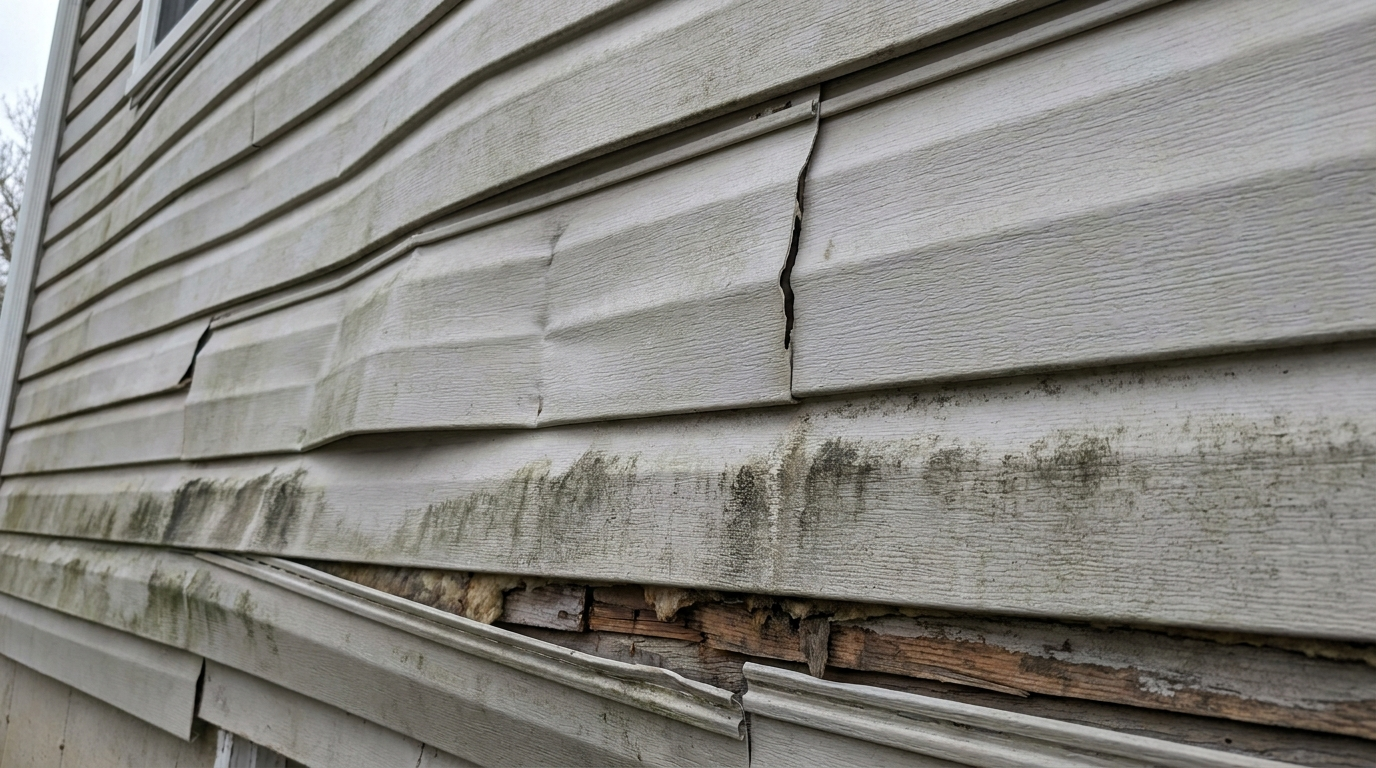
Warped, cracked and mildew-streaked vinyl siding panels showing the signs you need new siding in Stroudsburg

Siding Materials We Install in the Poconos

Standard vinyl is what goes on most Monroe County homes, and for good reason: it’s the best cost-to-durability ratio on the market and it doesn’t need painting. What matters is panel thickness — look for .044 inches or heavier. The thin builder-grade stuff is what buckles and cracks first in a cold snap.

Insulated vinyl has rigid foam bonded to the back. It costs more, but it stiffens the panel so it resists wind and hail better, quiets the house noticeably, and adds a modest R-value to the wall. At elevation — Mount Pocono, Pocono Pines and anywhere else that sees the worst of the wind — it’s usually the upgrade worth paying for.

Fiber cement is the heavy option. It won’t dent, woodpeckers and carpenter bees can’t work it, and it holds paint for a long time. It costs more, weighs considerably more, and takes longer to install. On an exposed lot backing onto woods, it can be the last siding the house ever needs.

Here’s the honest part: for most homes in Stroudsburg, a quality vinyl in a mid-range color does the job for decades and leaves money in your pocket. We’ll tell you when the upgrade earns its keep and when it doesn’t.

Our Siding Installation Process in Stroudsburg, PA

1. Free on-site inspection. We walk all four elevations, pull a panel where we need to, and check the sheathing and the flashing where the roof meets the wall. You get a written assessment of what’s failing and what isn’t.

2. Written quote with the material spelled out. Brand, panel thickness, trim details, and what happens to the old siding. No “siding — $X” one-liners.

3. Tear-off and repair. Old siding comes off, damaged sheathing gets replaced, house wrap goes on with the laps running the right way, and flashing is installed at every penetration and transition.

4. Installation and cleanup. Panels go on hung, not pinned — vinyl has to be able to move. We run a magnet over the yard for nails, haul everything out, and walk the job with you before we leave.
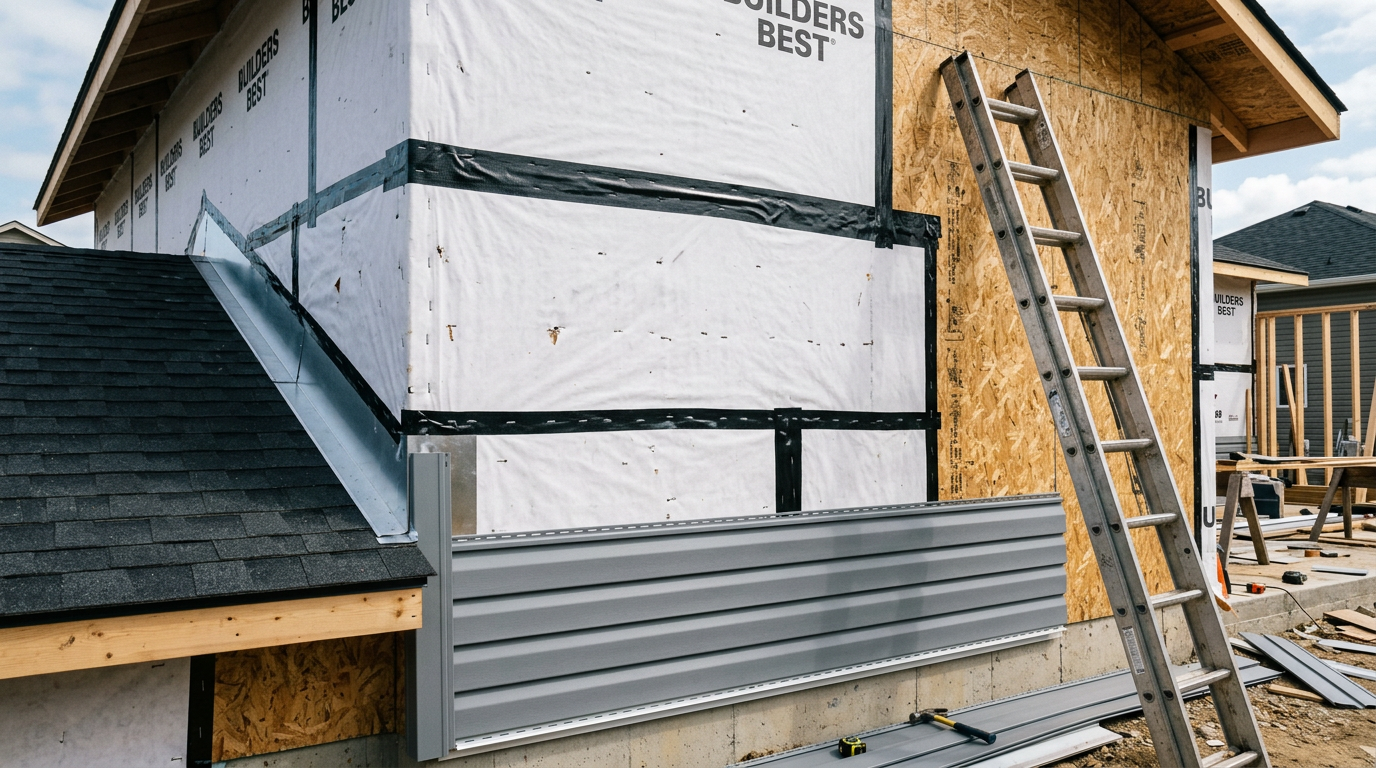
House wrap and wall flashing installed over sheathing during the siding installation process in Stroudsburg PA

Siding Cost in Stroudsburg, PA

Siding is priced by the square foot of wall, not floor space, so two houses with the same listing size can quote very differently. National cost data for 2026 puts vinyl siding at roughly $4 to $12 per square foot installed, with most full-house projects landing between $8,500 and $20,000, and fiber cement running $6 to $15 per square foot. Treat those as a sanity check on any quote you receive, ours included.

What actually moves the number on your house:

  • Wall area and number of stories — a two-story colonial needs staging that a ranch doesn’t.
  • Corners, windows, dormers and gables. Cutting and trim work is labor, and a complicated elevation can cost more than a larger plain one.
  • Sheathing condition. This is the variable nobody can price from the driveway. Rotted sheathing found at tear-off gets replaced, and that’s real material and labor.
  • Material and thickness — standard vinyl, insulated vinyl or fiber cement.
  • How many layers come off, and whether there’s asbestos-era material underneath on an older home.

Two things we’d rather say up front. If only one elevation is damaged and the rest of the wall is sound, replace that elevation, not the whole house — matching an existing color is usually possible and it’s a fraction of the cost. And if your siding is cosmetically tired but structurally fine, a proper wash may buy you several years. We’d rather quote you honestly now than replace a wall that didn’t need it.

For a real number on your house, we walk it and put it in writing: (570) 426-3505.

Benefits of Professional Siding Installation

Siding looks like the most DIY-able job on a house, and it’s the one we’re called to fix most often after someone tried.

The reason is counterintuitive: vinyl siding has to hang loose. A panel expands and contracts more than half an inch across a wall between a January morning and a July afternoon. Nails go in the center of the slot, snug but not tight, and the panel has to slide. Nail it down hard — the instinct of anyone who has ever hung anything — and it buckles into waves by the first hot week, and the manufacturer’s warranty is void.

The rest of the value is invisible once the job’s done: house wrap lapped so water sheds outward, flashing at every window head and wall-roof transition, the bottom course left open so the assembly can drain and dry, and J-channel run so it doesn’t funnel water behind the panel. Get those right and the wall lasts decades. Get them wrong and the siding looks fine while the sheathing rots behind it.

There’s also the roof line. A siding contractor who doesn’t do roofs will side right up to a failing kick-out flashing and leave it. We’re on roofs every day, so we fix that transition while the wall is open — it’s the cheapest it will ever be to fix.

Why Choose Allesson Roofing & Siding in Stroudsburg

We’re based at 312 Sarah Way in East Stroudsburg — not a call center routing your job to a crew from three counties away. When you call, you’re talking to the people who will be on your house.

One crew handles the roof and the walls. That matters more than it sounds: most chronic water problems on a Poconos home happen exactly where those two systems meet, and that’s the seam where two separate contractors point at each other. We own the whole detail.

We know what this climate does. The freeze-thaw cycles at elevation, the ice damming that pushes water back under fascia and soffit, the wind exposure on open ground out toward Saylorsburg, the constant damp along the river in Delaware Water Gap. A siding spec that’s fine in Philadelphia isn’t automatically right at 1,900 feet in Mount Pocono.

And we’ll tell you when you don’t need us. If your siding has ten good years left, that’s what the inspection will say.

Free siding inspection across Stroudsburg, East Stroudsburg, Mount Pocono, Saylorsburg and Monroe County. We’ll walk all four elevations, check what’s behind the panels, and give you the honest version — repair, partial replacement, or full job.

Call (570) 426-3505 or request a visit through the form. If your roof is due around the same time, ask us to price both together; doing them in one mobilization usually saves you money.

Frequently Asked Questions About Siding in Stroudsburg, PA

How long does siding last in the Poconos?
Quality vinyl typically gives 25 to 40 years here, though our freeze-thaw cycling and UV exposure tend to push real-world life toward the lower half of that range. Fiber cement generally lasts longer. What kills siding early is almost never the material — it’s a bad installation that didn’t let the panels move or didn’t manage water behind them.

Can you replace just one section instead of the whole house?
Often, yes, and we’ll recommend it when the rest of the wall is sound. The honest caveat is color: vinyl fades over the years, so a new panel next to a fifteen-year-old one rarely matches perfectly. On a back or side elevation most homeowners find that an easy trade for the savings.

Will homeowners insurance cover siding damage?
Sudden damage from a storm — wind, hail, a falling limb — is usually covered. Fading, oxidation, cracking from age and normal wear are not; that’s maintenance, and no carrier pays for it. If the fix is likely to land near or below your deductible, filing a claim usually costs you more than it returns.

Can siding be installed in winter in Pennsylvania?
Yes, with adjustments. Vinyl gets brittle in the cold, so panels have to be cut and handled differently and expansion gaps set for the temperature on the day. We do winter installations here every year. If the job isn’t urgent, spring or fall is easier on the material and usually on the schedule.

Do I need a permit to re-side my house in Monroe County?
It depends on your municipality — some require a permit for a full re-side, others treat like-for-like replacement as an ordinary repair. Requirements in Stroud Township aren’t automatically the same as in Coolbaugh. Check with your municipal code office, or let us confirm it before the job starts.

Does new siding actually lower heating bills?
Standard vinyl on its own does very little — it’s a rain screen, not insulation. Insulated vinyl adds a modest R-value and, more importantly, the tear-off is your one easy chance to air-seal and add insulation to the wall cavity while it’s open. That combination is where real savings come from, not the panel by itself.